
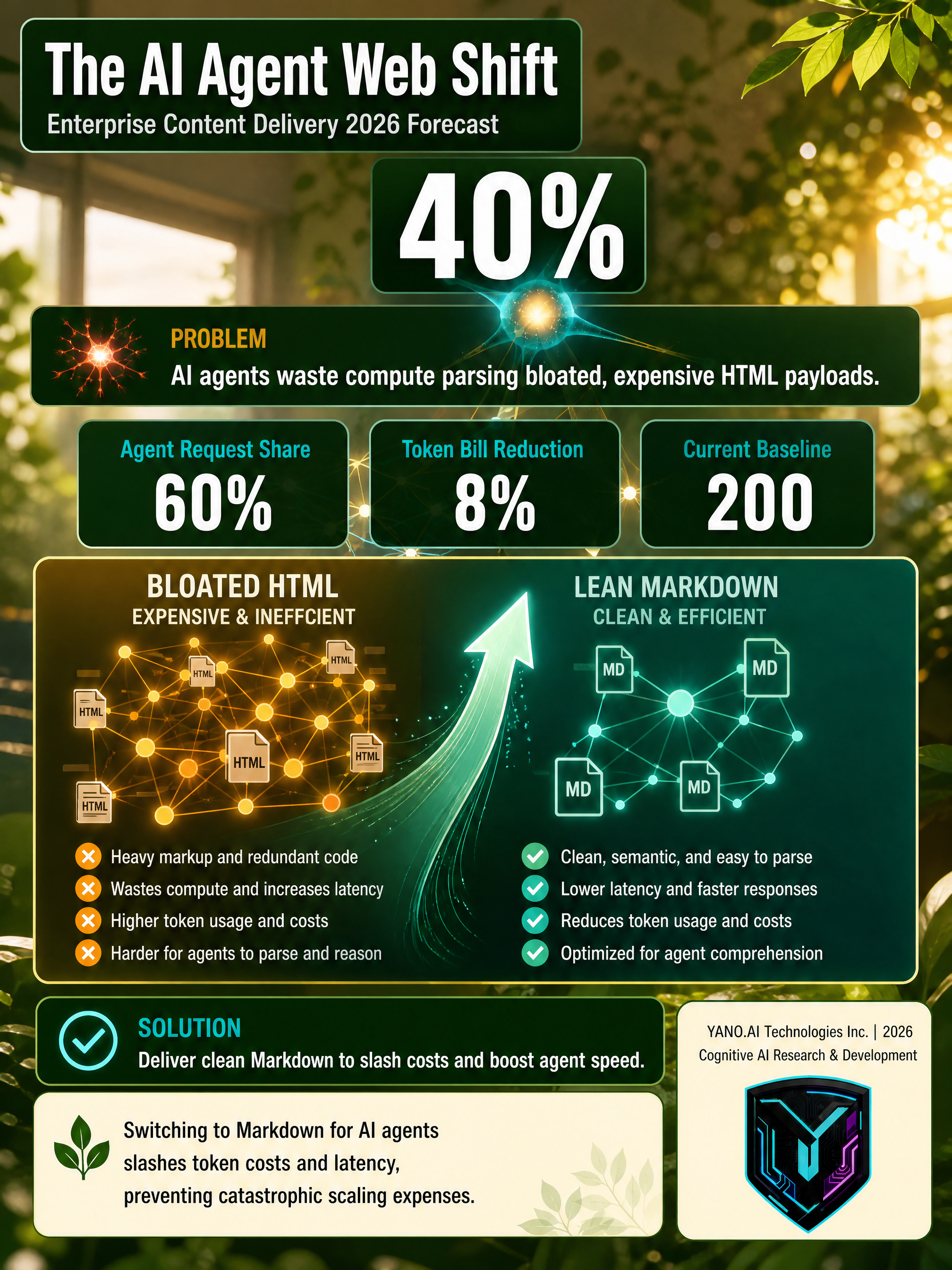
By the end of 2026, 40% of enterprise web requests will come from AI agents rather than human browsers — up from less than 8% today. Most of those agents are still parsing HTML the slow way. A small, growing group of infrastructure teams have decided that's a waste of everyone's compute. They're flipping a single HTTP header and watching their token bills drop by 60%.
Here's what happened when the web's oldest data format met the web's newest consumers.
The Real Cost of HTML to an Agent
When an AI agent fetches a product page, a docs site, or a help center article, it almost never sees what a human sees. It receives the full HTML payload — every <div>, every inline script reference, every ad tracker. It then has to strip, parse, and re-construct the page before any reasoning happens.
For a single request that's fine. For an agent doing a 200-step research run, it's catastrophic. Token spend scales with input size, and HTML is roughly 8x larger than the underlying content it wraps. Multiply that by 200 calls and you're paying for the same content four or five times over.
A new protocol called Accept Markdown — promoted by acceptmarkdown.com and picked up by several large content networks in Q3 2025 — gives agents a way out. Clients send Accept: text/markdown in the request. Servers that recognize the header respond with a clean, semantic Markdown rendering of the page. The HTML stays where it is. The agent gets exactly what it would have produced after parsing — except cheaper, faster, and deterministic.
Why 2026 Is When the Shift Becomes Urgent
Three forces are colliding at the same time.
1. Agent traffic is no longer experimental. Runable raised a $21M Series A in August betting that AI agents can go from building businesses to running them. Okta lifted its full-year outlook in the same week, citing AI agent demand as the primary driver. Salesforce's agent business is now growing over 200% year over year, though the order book still hasn't caught up. These are not pilot programs — they're production systems with real budgets.
2. Local agents are going mainstream. Perplexity and NVIDIA announced Portable Computer in August — a fully local AI agent that runs on consumer hardware without sending data to the cloud. The pitch: zero-latency reasoning, full data sovereignty, no per-token API bill. Local agents hit the same HTML problem, but they feel it harder because there's no remote parsing pipeline to hide the cost. The teams shipping local agents are the ones pushing hardest for clean markdown delivery — every kilobyte they save is battery life on the user's device.
3. The boring infrastructure is finally ready. The pieces that make Accept: text/markdown work in production — CDN rules, edge functions, content negotiation middleware — were either nonexistent or fragile 18 months ago. Cloudflare Workers, Vercel Edge, and Fastly all shipped first-class content negotiation in the last year. A team can now ship Accept Markdown support as a 12-line middleware and roll it out to production before lunch.
The Practical Pattern
A working implementation is small. On the server, intercept the request, check the Accept header, and if it contains text/markdown, return the canonical markdown source instead of the rendered HTML. Cache both representations separately at the edge so you're not re-rendering on every call.
GET /docs/getting-started
Accept: text/markdown
The response is the raw markdown — the same file the docs team wrote, with no template wrapper, no tracking pixel, no nav chrome. The agent reads it, reasons over it, and moves on.
For teams that don't control the origin server, reverse-proxy middleware can intercept and rewrite. For teams that do, the cleanest move is to expose a /<page>.md route alongside the HTML one and let the agent request the cheaper path explicitly.
What the Skeptics Are Missing
A common objection: "Agents should just parse HTML. That's what browsers do." Two problems with that.
First, browsers don't parse HTML — they render it. The parsing work was offloaded to a 30-year-old stack of rendering engines that nobody is rewriting. Agents don't have a rendering engine. They have token budgets.
Second, the same content served in markdown is not just smaller — it's more reliable. HTML structures shift when a CMS template changes. Markdown doesn't. An agent that trained on the markdown version of your docs will still parse it correctly in six months, even after a redesign. That's a real operational benefit, not a theoretical one.
What to Ship This Quarter
Three things, in order:
- Add the header to your agent clients. It's one line of code and immediately tells every participating server that you want markdown. If you don't ask, you don't get.
- Serve markdown when asked. Even a basic middleware that returns the raw
.mdfile for any URL ending in.mdis enough to capture most of the benefit. - Track the metric. Add a server-side log line for
Accept: text/markdownrequests. Most teams that ship this discover that 20-30% of their agent traffic was asking for clean content within a week.
The web's content layer is about to negotiate with its consumers in a way it never has before. The teams that win the next two years of enterprise AI won't be the ones with the largest models — they'll be the ones who figured out how to ship the right bytes to the right clients for the right price.
What does your content stack look like for non-human consumers right now? If you can answer that in one sentence, you're ahead of most. If you can't, that's the first thing to fix.
Sources:
- Accept Markdown protocol announcement, acceptmarkdown.com, 2025
- Runable $21M Series A coverage, TechCrunch, August 2026
- Okta full-year outlook revision, Wall Street Journal, August 2026
- Salesforce Agentforce growth disclosure, Salesforce Q2 FY27 earnings call, August 2026
- Perplexity Portable Computer launch with NVIDIA, August 2026
- The Trade Desk agentic H2 2026 deck reporting, ADWEEK, August 2026
Sources — external references open in a new tab.