
Everyone says Filipino small businesses need better software. The data says they already have access. Philippine MSME surveys keep coming back with the same finding: owners want to adopt digital tools, but only a small fraction use them daily because of skills gaps. That is not a technology problem. That is an education and training problem. Edtech is the missing layer in the country's digitalization story. (Source: PrimeCode WebWorks, 2026)
The Tools Are Not the Bottleneck
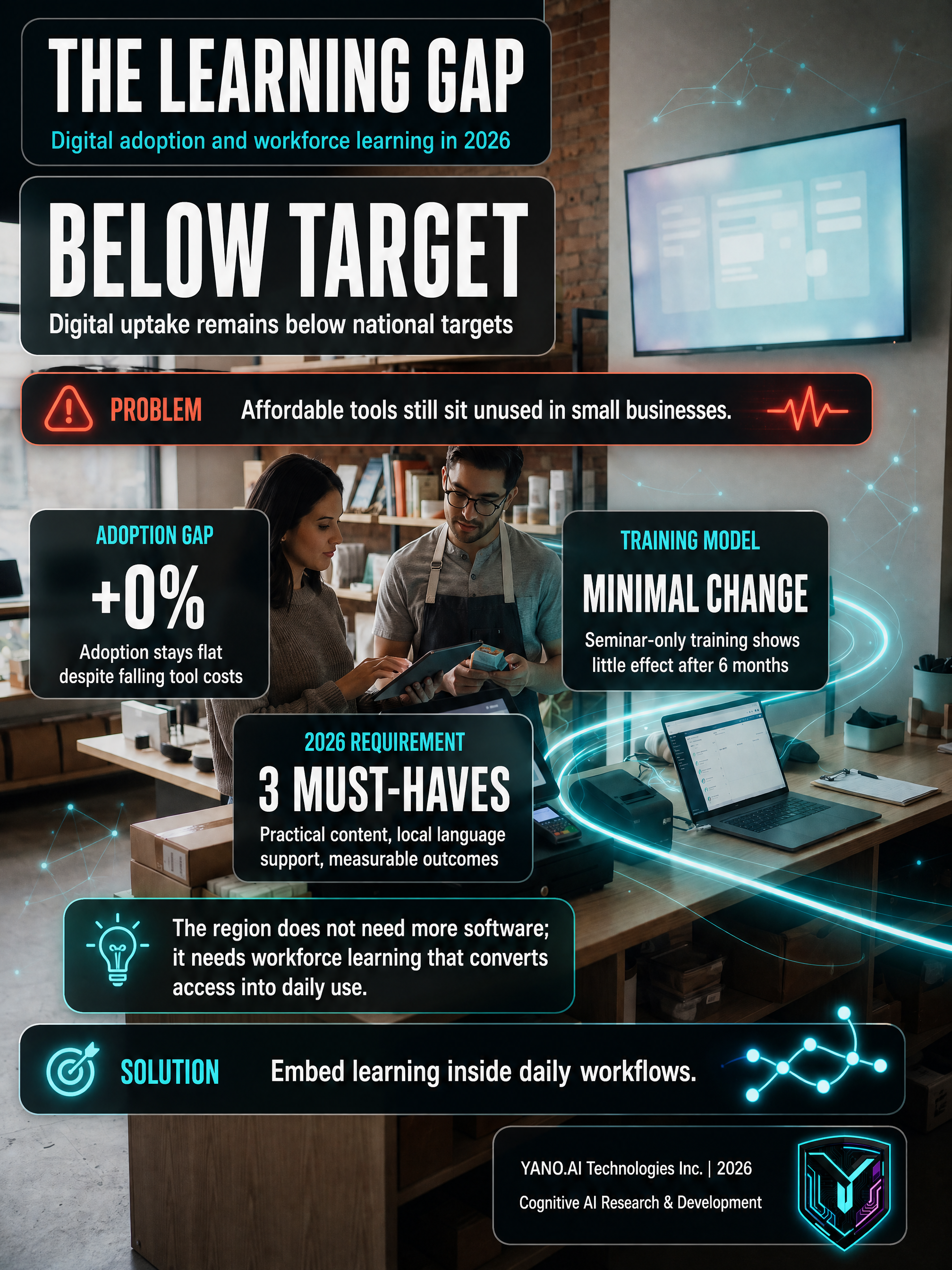
Over the last few years, accounting platforms, inventory systems, and even AI-powered automation tools have become affordable enough for small operations. A sari-sari store owner in Laguna can now subscribe to cloud-based inventory software for less than the cost of a daily delivery run. A metro Manila coffee stand can use AI scheduling tools instead of spreadsheets. Yet adoption numbers remain flat. The Department of Trade and Industry's MSME Development Plan 2023-2028 notes that digital uptake among microenterprises is still well below national targets. The bottleneck is not the price of software. It is the confidence and competence to deploy it inside a business that already has too much on its plate. (Source: OpenGov Asia, 2024)
Small business owners do not lack information. They lack guided practice. Most digital onboarding materials are written for corporate employees who have dedicated time for training. A microenterprise owner does not have two hours on a Tuesday to read a help center article while the shop is open. They need instruction that fits between orders, deliveries, and payroll. Edtech designed for large enterprises misses this constraint entirely. The result is a shelf full of unused subscriptions and a persistent belief that digitalization is for bigger players.
Why One-Day Seminars Do Not Stick
Traditional training models in the Philippines rely on short workshops, government roadshows, and occasional LGU-sponsored sessions. Those events raise awareness. They rarely change behavior. Research on Philippine SME digitalization shows that firms exposed only to seminar-style training show minimal operational change six months later. The reason is simple: skills decay when there is no follow-up, no practice environment, and no accountability loop. Edtech can fix this by embedding learning directly into the workflows that employees already use. Microlearning, simulation-based modules, and AI-guided practice allow a worker to build competence without leaving the shop floor. That is a different model from classroom-style instruction. (Source: Entrepreneurship.org.ph, 2024)
The gap between attendance and application is where most training budgets disappear. An owner might leave a DTI-sponsored seminar excited about inventory digitization. Three weeks later, they are back to handwritten stock cards because no one was there to answer questions when the first upload failed. Sustained adoption requires support structures that live inside the business, not inside a conference hall.
What 2026 Is Demanding From Edtech
This year, the conversation around Philippine SMEs has shifted from "should we digitalize" to "how do we digitalize without hiring expensive specialists." AI automation is no longer optional for competitive businesses. But adopting AI requires a baseline level of digital literacy that most microenterprise teams still do not have. The gap creates a paradox: businesses are expected to modernize, yet their learning investments remain outdated. Practical workforce education platforms need to deliver three things: BIR-aligned practical content for finance and admin tasks, local language support, and outcomes that owners can see in monthly reports. Without those, another round of digital adoption surveys will return the same disappointing numbers. (Source: BotsAtWork.ph, 2026)
Edtech that speaks the local context - payment cycles, permit workflows, seasonal demand spikes, and barangay-level customer behavior - will win. Generic global modules do not map well to a Philippine retail or service operation. The winners in this space will be platforms that combine task-based learning with real business outcomes rather than completion certificates. Investors looking at the Philippine edtech market should ask whether a platform can demonstrate skill transfer to actual business performance, not just course completion rates.
FAQ
Q: Are digital tools really affordable for Philippine microenterprises?
A: Yes. Many platforms now offer entry-level tiers priced for small operations, and some even support installment or usage-based billing. The cost barrier is lower than it was three years ago.
Q: Why do MSME owners attend training but still not adopt digital tools?
A: Seminar exposure does not create behavior change. Owners and employees need ongoing, workflow-embedded practice, not one-day events.
Q: What should an edtech platform prioritize for Philippine SMEs?
A: Local business context, BIR-relevant content, Filipino language options, and measurable outcomes linked to daily operations.
Key Takeaway
The Philippines does not need more digital tools. It needs more digital learners. Edtech that is built around local workflows, local language, and local compliance will do more for SME growth than any new software release. If you are building or funding edtech for this market, stop benchmarking against Silicon Valley success stories. Start benchmarking against whether a barangay microenterprise can finish a module and use the result by Friday. That is the standard that matters.
What if the next great Philippine tech unicorn is not a SaaS tool, but the learning layer that finally makes existing tools actually work?
Sources
Sources — external references open in a new tab.