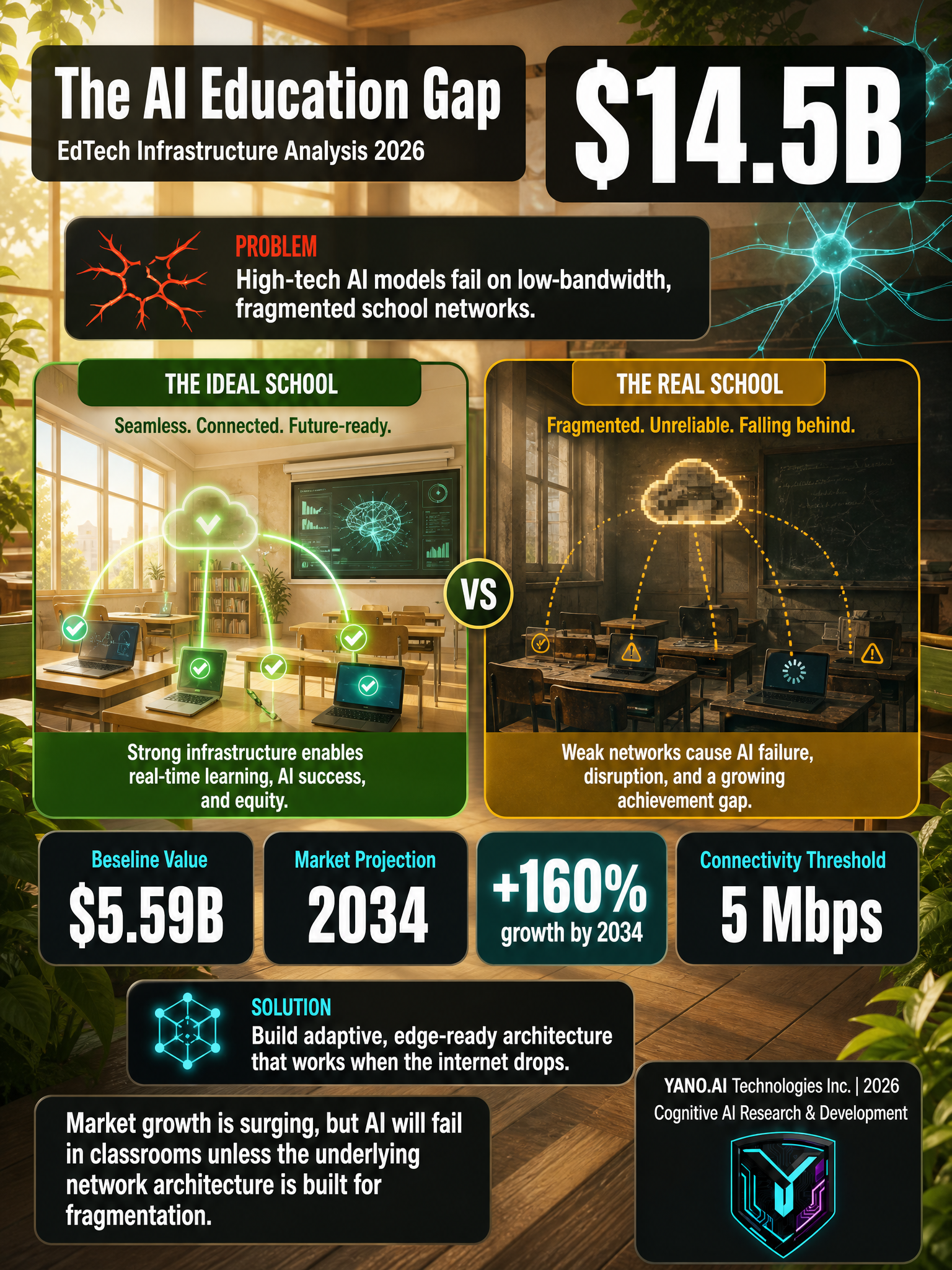
By 2034, the Philippines EdTech market will reach USD 14,554.1 million - up from USD 5,593.6 million in 2025 (Source: IMARC Group, 2025). That growth sounds like a win. It sounds like schools are ready for AI. The market numbers only tell half the story. The other half is whether the architecture underneath can actually hold the weight.
The Real Bottleneck Is Not the Model
Everyone focuses on which AI model to use. The harder problem is the school network. Many public schools still rely on intermittent connectivity. Deploying an AI tutor that streams real-time inference requires more than a good API key. It requires edge-ready infrastructure, offline-capable clients, and a content distribution strategy that works on a 5 Mbps connection during peak hours. DepEd's Digital Maturity Assessment tool was built precisely because officials wanted to see what happens when schools actually try to use EdTech under real conditions (Source: EdTech Hub, 2026). The results were not encouraging. Connectivity gaps, device shortages, and inconsistent power support meant that even well-designed platforms delivered uneven results.
How AGAP.AI Is Trying to Solve the Backend Problem
DepEd's AGAP.AI program, launched in January 2026, is more than a literacy campaign. It is a bet that AI can be packaged as a support layer for teachers rather than a replacement. Reading Progress and other AI-powered tools were rolled out nationwide with Microsoft support, yet the rollout still depends on school-level readiness (Source: Microsoft News Asia, 2026). From an architecture perspective, that means a centralized model sitting on top of a fragmented edge. If the edge is weak, the system fails at the classroom door. Secretary Sonny Angara has framed AI as an ethical support tool rather than an autonomous decision-maker, which is the right posture for a public system (Source: Philippine News Agency, 2026). But ethics only matter if the infrastructure is reliable enough to deliver consistent outputs.
Data Governance and Model Trust at Scale
Government AI projects need clear data rules. DepEd Order No. 003, s. 2026 established foundational guidelines for AI use in Philippine schools, signaling that policy is trying to catch up with deployment (Source: DepEd, 2026). The challenge is implementation. Schools need standard data formats, consent workflows for minors, and audit trails that show how an AI recommendation reached a teacher or student. Without that layer, even accurate models become black boxes. A national AI framework gains credibility only if it can explain itself to a principal in a rural school who does not have an IT team.
Building for Fragmentation Instead of Assuming Unity
Most EdTech architectures assume uniform conditions. Philippine public education does not have uniform conditions. Regional offices have different technical capacity. School divisions have different procurement cycles. Teachers have different comfort levels with digital tools. The CHED RAISE 2026 platform showed that collaboration is possible across institutions, but collaboration is not the same as shared infrastructure (Source: CHED, 2026). A resilient AI architecture for Philippine education needs adapters, not a monolith. It needs local caching, modular APIs, and fallback modes when cloud services are unreachable. Those choices are unglamorous, but they are what separate a pilot that gets praised at a summit from a system that actually works in a classroom.
FAQ
Q: Is AI adoption in Philippine schools moving too fast?
A: Adoption is accelerating, but many schools still lack the connectivity and devices needed for reliable AI-assisted learning. The risk is not speed; it is uneven deployment.
Q: Who is leading the national AI push in education?
A: DepEd is driving the flagship programs, with support from CHED and partnerships such as the Microsoft collaboration on AGAP.AI.
Q: What is AGAP.AI?
A: AGAP.AI is DepEd's flagship program for AI-powered literacy and teacher support, launched in early 2026.
Q: Will AI replace teachers in Philippine public schools?
A: Current policy frames AI as a support tool, not a replacement. DepEd Secretary Sonny Angara has stated that AI will be used to assist, not replace, educators.
Key Takeaway
AI in education will only deliver results if the architecture underneath is built for the real school, not the ideal one. The Philippines has the ambition and the market growth to support a national AI learning system. The missing piece is a production-ready backend that handles poor connectivity, inconsistent devices, and local decision-making. The schools that win will not be the ones with the newest models. They will be the ones with the systems that still work when the internet drops.
Should DepEd prioritize a single national AI platform or let regions build their own modular systems?
Sources
- DepEd and Microsoft Accelerate Learning Recovery and AI Literacy for Filipinos
- Designing EdTech for Foundational Literacy and Numeracy: Insights from the Philippines
- Brightening the Future of Philippine Education
- Philippines Ed Tech Market 2026: Digital Learning Expansion, AI-Powered Education and Skills-Focused Training
- DepEd Secretary on Ethical AI Use in Education
Sources — external references open in a new tab.