
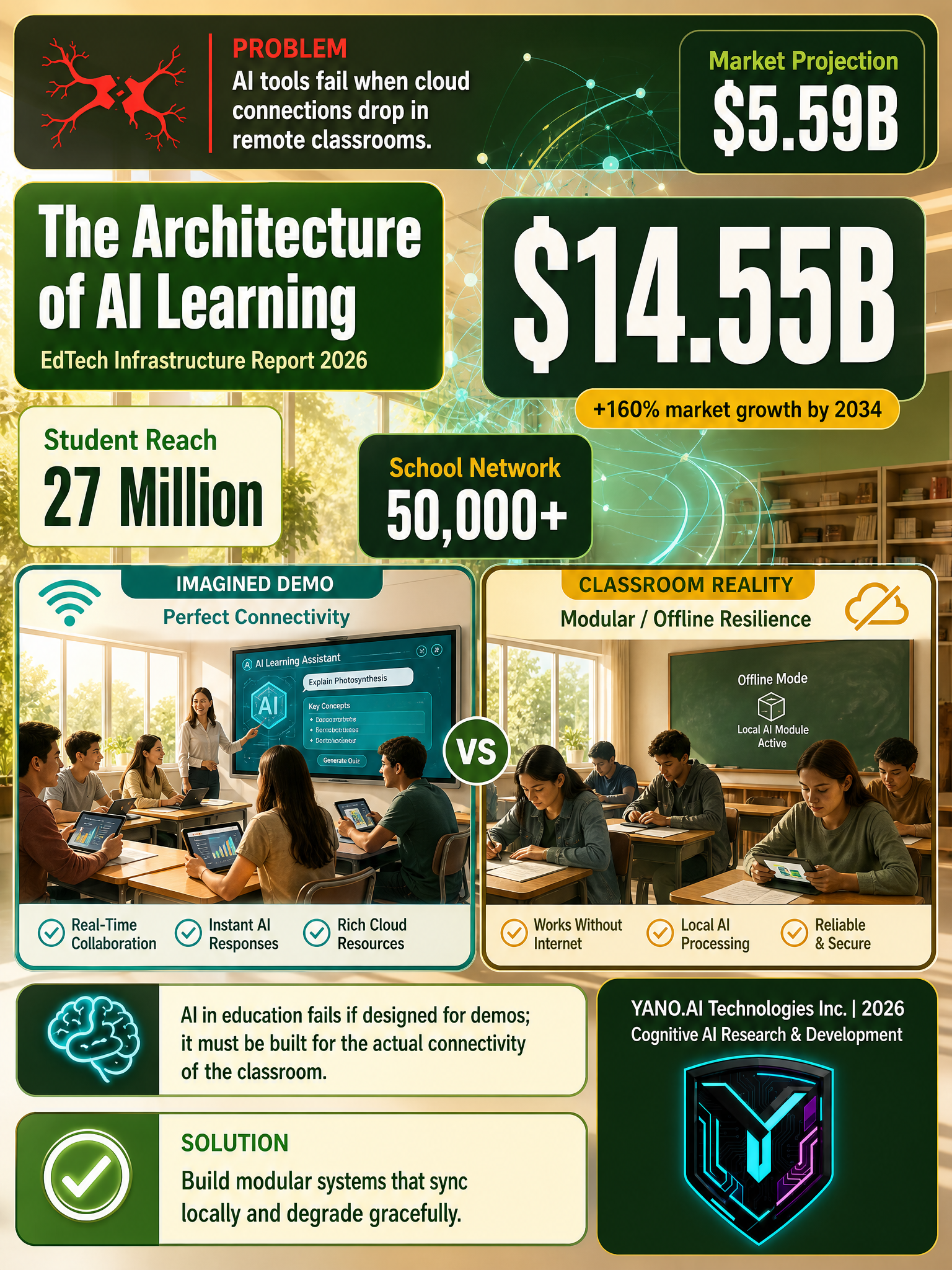
Last January, the Department of Education launched Project AGAP.AI with Microsoft, promising AI-powered literacy tools for learners and teachers nationwide. By February, DepEd had issued Order No. 003, s. 2026, laying out foundational guidelines for responsible AI use in schools. The goal is clear: serve roughly 27 million students across more than 50,000 public schools. The harder question is whether the underlying architecture can support that promise at scale.
The Scale Problem Most Announcements Skip
A nationwide AI rollout in education is not a software installation. It is a coordination problem across connectivity, device access, teacher readiness, and data governance. DepEd's partnership with Microsoft includes Reading Progress and AGAP.AI, tools designed to boost literacy and teacher support (Source: Microsoft, 2026). But the market data already suggests demand is outpacing implementation readiness. The Philippines EdTech market reached USD 5.59 billion in 2025 and is projected to hit USD 14.55 billion by 2034 (Source: IMARC Group, 2026). That growth signal is real. It also means infrastructure decisions made today will lock in behavior for years.
The architecture challenge is not unique to the Philippines. Large-scale education technology deployments worldwide have struggled with the gap between policy ambition and classroom reality. What makes the Philippine case urgent is the combination of scale and timeline. DepEd is not running a five-year pilot in a single city. It is attempting to integrate AI into the daily workflow of one of the largest public school systems on the planet. Every delay in connectivity, every device specification mismatch, and every data format incompatibility multiplies across millions of users.
Architecture Choices Behind the Policy
DepEd's AI guidelines treat AI as a support tool rather than a replacement for teachers (Source: Philippine News Agency, 2026). That framing does not resolve the technical reality. An AI literacy tool needs reliable internet, standardized device specifications, and interoperable data formats. The missing piece in most coverage is the systems layer: APIs, identity management, offline fallback behavior, and how classroom data flows back into model improvement.
The policy documents mention responsible use and teacher support. They do not mention latency budgets, API rate limits, or what happens when the cloud connection drops during a lesson. CHED's RAISE 2026 summit and discussions around a possible National AI Framework show that higher education stakeholders are also grappling with these same infrastructure questions (Source: CHED, 2026). Those are architecture decisions being made implicitly rather than explicitly. In a deployment this large, implicit architecture decisions become permanent constraints within months. Once schools adopt a specific toolchain and workflow, switching costs rise sharply.
Digital Maturity Before AI Maturity
The EdTech Hub worked with DepEd to stress-test a Digital Maturity Assessment tool across school environments. The lesson is that schools do not move from analog to AI in one step (Source: EdTech Hub, 2026). They move through foundational digital practices first. That matters for architecture because it changes deployment sequencing. A model optimized for high-connectivity urban schools will fail in remote areas with intermittent bandwidth. Yet most public AI education programs are designed as top-down platforms rather than modular systems that degrade gracefully. If the architecture assumes perfect conditions, the actual rollout will produce uneven adoption and uneven learning outcomes.
A modular approach would mean the same AI literacy tool works differently depending on connectivity. It would sync progress locally and reconcile later. It would let teachers override recommendations without breaking the data chain. Those are design decisions made by engineers before a single school goes online. The Digital Maturity Assessment tool was supposed to surface these gaps before large-scale procurement. Whether that feedback loop actually influences architecture choices remains to be seen.
What Founders and Policymakers Should Watch
Philippine education technology is moving from pilot to policy faster than the infrastructure can keep up. That creates both risk and opportunity. The risk is large-scale deployment with brittle systems. The opportunity is that whoever solves the architecture for low-connectivity, high-scale classroom AI will have built something exportable. The current signals from DepEd, CHED, and private partners suggest the next twelve months will define whether AGAP.AI becomes a cautionary tale or a reference model. The technical community should be watching implementation details, not just announcement dates.
For startup founders, this is a signal that government-scale procurement is opening in AI education. The winners will not necessarily be the best algorithms. They will be the teams that can demonstrate reliability at scale, offline resilience, and clear data governance. For policymakers, the lesson is that architecture oversight belongs in the same conversation as curriculum and budget. Infrastructure reviews should happen before deployment commitments, not after complaints reach the department office.
Key Takeaway
AI in education only works if the infrastructure is designed for the classrooms that actually exist, not the ones imagined in product demos. The Philippines is about to run one of the world's largest real-world tests of that principle. The question is whether the architecture will be ready when the first million students log on.
FAQ
Q: Is AGAP.AI already deployed nationwide?
A: It is rolling out in phases, with AI literacy tools and Reading Progress expanding across public schools through the DepEd-Microsoft partnership.
Q: What is DepEd Order No. 003, s. 2026?
A: It is the department's foundational guidelines for responsible AI use by learners and teachers nationwide.
Q: Will AI replace teachers in Philippine classrooms?
A: Current policy frames AI as a support tool, not a replacement. The stated goal is teacher assistance and literacy improvement.
Sources
- Microsoft: DepEd and Microsoft Accelerate Learning Recovery and AI Literacy for Filipinos
- IMARC Group via Vocal Media: Philippines EdTech Market 2026
- Philippine News Agency: DepEd Allows Responsible AI Use Among Learners, Teachers Nationwide
- EdTech Hub: Designing EdTech for Foundational Literacy and Numeracy - Insights from the Philippines
- CHED: RAISE 2026 Advancing AI for Societal Empowerment
Sources — external references open in a new tab.