
The numbers are in, and they're sobering. Despite the relentless hype around AI agents, nearly 40% of enterprise agent projects are failing — not because the technology doesn't work, but because teams are building architectures they don't need.
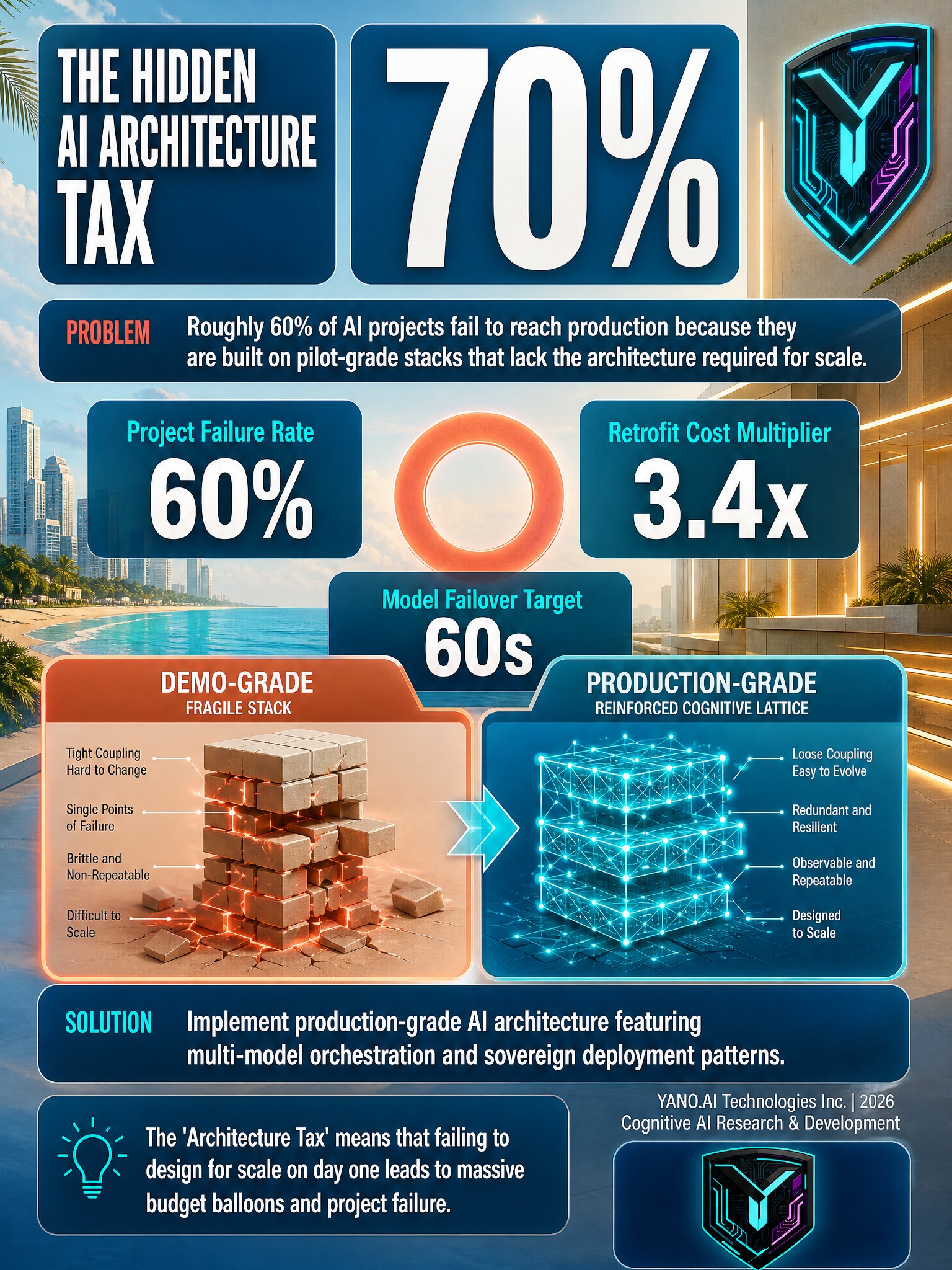
The culprit? Over-engineering.
Companies are racing to deploy multi-agent swarms, agentic orchestrators, and autonomous decision loops before they've solved the fundamentals. One well-known enterprise reportedly spent $1.3 million monthly running over 100 AI agents, only to discover that a single well-tuned agent with clean tool integration outperformed the entire swarm on core business metrics.
The Monolith vs. The Swarm
The 2026 conversation has shifted decisively. Last year, the question was "Can we build an AI agent?" This year, it's "Should this be one agent or many?"
The emerging consensus from production deployments across fintech, cybersecurity, and enterprise SaaS points to a clear pattern: single-agent architectures still dominate where reliability matters, and multi-agent systems add value only when tasks are genuinely decomposable.
"Stop trying to force a single LLM to be your entire company's operating system," argues the lead architect at a Series B AI infrastructure company. "The future of enterprise AI isn't one giant brain — it's a coordinated swarm of specialists. But you don't start with the swarm. You earn it."
This tracks with what we're seeing in the Philippine tech sector: startups that launched with ambitious multi-agent architectures in 2025 are now consolidating into leaner, single-agent-plus-tool designs. The ones who stayed lean from the start are shipping faster.
Five Patterns That Actually Work
Production data from teams running agents at scale has crystallized into five durable design patterns:
The Router Pattern — A single orchestrator agent that classifies intent and delegates to specialized tools or sub-agents. Low complexity, high reliability. Think of it as an AI traffic controller.
The Chain Pattern — Sequential agent handoffs where each step produces validated output before the next begins. Common in document processing, compliance checks, and multi-step approval workflows.
The Supervisor Pattern — One agent monitors and course-corrects others in real time. This is where multi-agent starts to earn its keep: when tasks are genuinely parallel and need coordination.
The Tool-Augmented Solo Agent — One capable agent with well-defined tools (APIs, databases, code execution). This remains the workhorse pattern for 60-70% of production use cases.
The Human-in-the-Loop Gate — Every autonomous decision above a risk threshold requires human approval. This isn't a weakness; it's the pattern that lets you sleep at night.
The Cost Problem Nobody Talks About
Agent architectures have a dirty secret: token economics punish complexity. Every agent-to-agent handoff, every reasoning loop, every retry burns tokens. A poorly designed multi-agent system can consume 10-20x the tokens of an equivalent single-agent implementation for the same outcome.
One deployment we analyzed went from 850,000 tokens per task (three-agent swarm) to 95,000 tokens (single agent with tools) — same task completion rate, 89% cost reduction.
The math is simple: every additional agent is a multiplier on your inference bill. If you're running on a per-token pricing model, that multiplier compounds fast.
What Actually Changes Product Design
Beyond architecture, the most profound shift in 2026 is how agents are reshaping product interfaces. When an AI can autonomously update a CRM, book meetings across calendars, and manage a sales pipeline — all within a single task thread — the traditional dashboard-centric UI becomes secondary.
The product becomes the agent's capability surface, not the screen it renders on.
For Philippine startups building in fintech, healthtech, and agritech, this is the real opportunity: skip the complex UI layer. Build the agent that does the thing. Let the interface follow the capability.
The Takeaway
If you're starting an agent project today, here's the sequence that shipping teams are converging on:
- Build the solo agent first. One model, clear tools, clean API boundaries.
- Measure everything. Token usage, task completion rate, latency, cost per task.
- Decompose only when you hit a wall. If your solo agent can't handle scale or task diversity, that's your signal to add a second agent — not before.
- Gate at the right level. Autonomous for low-risk, human-approved for high-risk.
The teams winning in 2026 aren't the ones with the most impressive architecture diagrams. They're the ones shipping lean agents that actually work.
What's your experience with agent architectures? Drop your thoughts in the comments.
#AI #AgenticAI #MultiAgentSystems #EnterpriseAI #PhilippineTech #SoftwareArchitecture #AIDevelopment
Sources — external references open in a new tab.