
What if the neighborhood sari-sari store on the corner could forecast tomorrow's load, reorder stock from the supplier, and settle its BIR books - while the owner sleeps? By the end of 2026, that scenario is technically free for any micro-retailer with a smartphone. The hard part is everything else.
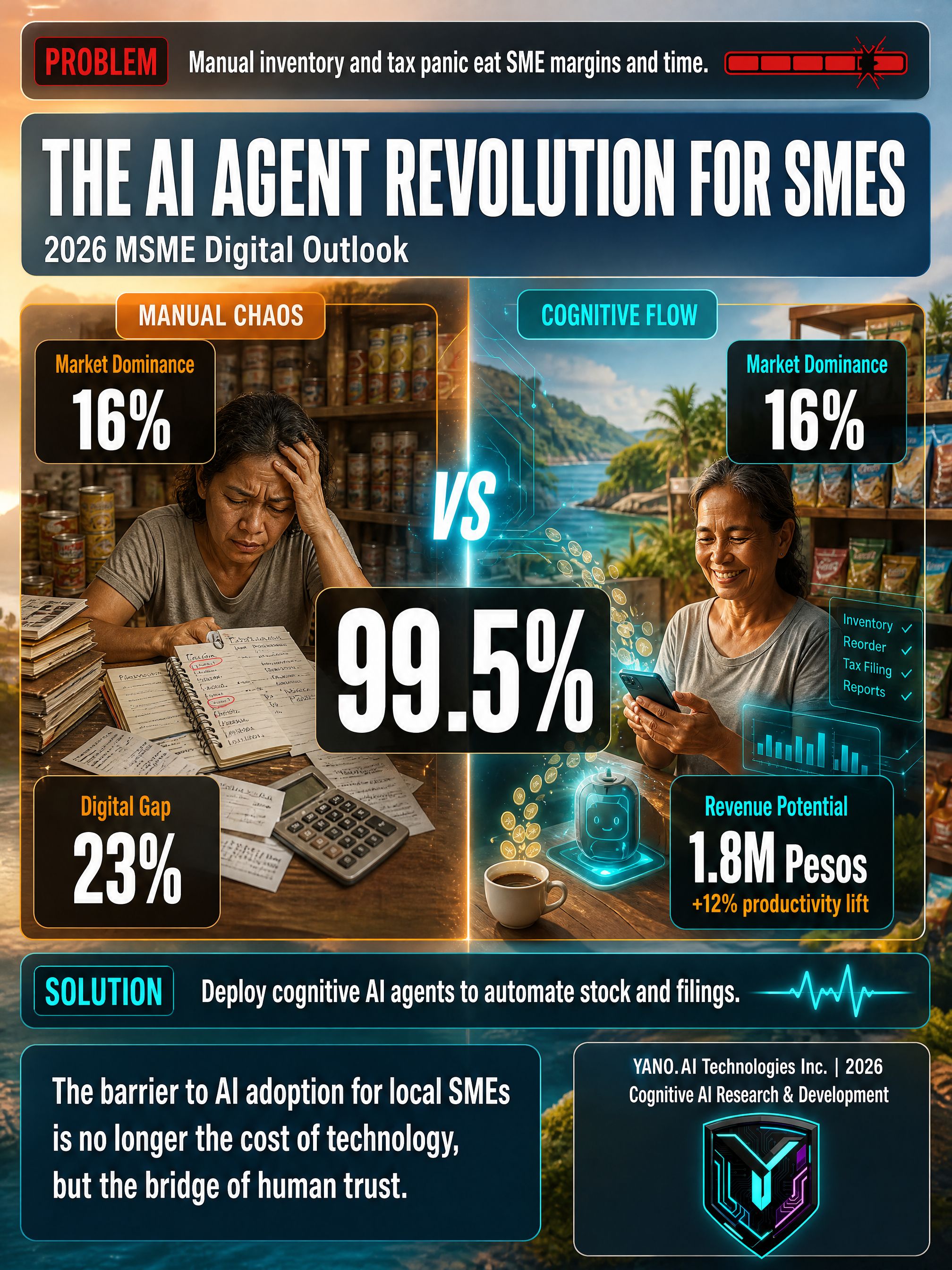
There are 1.1 million registered MSMEs in the Philippines, and they account for roughly 99.5% of all business establishments in the country (Source: DTI, 2024). They employ about 65% of the private-sector workforce. Yet most of them still track inventory in notebooks, file taxes once a year in a panic, and rely on a single owner's memory to make decisions. The technology gap is the loudest problem. The real gap is operational.
Why Philippine SMEs Are Still Running on 2014 Software
Only 16% of Philippine small businesses have an active e-commerce presence, and just 23% use any form of cloud accounting software (Source: Microsoft ASEAN SMB Digital Index, 2024). The most-cited reasons are not "tech isn't ready" - they are "I don't have time to set it up" and "I don't trust it with my money."
That hesitation is rational. A single bad data entry from an automation tool can wipe out a week's margin on a box of canned goods. For a micro-retailer running 20% gross margins, the downside of a wrong system is real, and the upside of a right system is invisible until the end of the month.
The Math Has Flipped: AI Agents Now Cost Less Than a Helper
Multi-agent AI systems in 2026 cost roughly the same as one full-time helper's monthly pay - and that number is still dropping (Source: Gartner, 2025). A basic three-agent setup for a small retailer (inventory watcher, supplier chatter, BIR report writer) can run on a single laptop and a 200-peso monthly API bill.
Compare that to hiring a bookkeeper at 12,000 pesos a month, or losing 8 hours a week to manual inventory counts. The economic argument flipped sometime in late 2025. Most Philippine SME owners have not been told.
What a Three-Agent Stack Actually Does
The first agent watches POS data and flags when stock of a fast-moving SKU is about to dry up. The second agent messages the supplier on Viber with the reorder, then confirms delivery by reading the GCash or Maya receipt. The third agent pulls the week's sales, reconciles digital payments, and drafts a monthly summary in BIR Form 2551Q format.
None of this is science fiction. The components exist now. The question is integration, and who pays for the first month.
The Three Frictions That Will Eat the Win
Connectivity remains the first wall. Philippine internet speeds in provincial areas average 35 Mbps, with latency that breaks real-time agent calls (Source: Ookla Speedtest, 2024). Agents that need to talk to live APIs have to be designed for offline-first sync, or they will fail on the second brownout.
Trust is the second wall. Filipino SME owners are famously loyal to people they know. Asking them to hand bookkeeping to a model they cannot see, from a vendor they have never met, requires a different kind of sales job than selling software features. It requires a friend, a coop officer, or a barangay official to vouch for it.
Compliance is the third wall. BIR has shifted toward digital invoicing and eBIRForms since 2023, and the rules for AI-generated records are still being written (Source: BIR, 2024). A small business that lets an agent file returns without a human sign-off is betting on rules that have not stabilized.
The Opportunity Hidden Inside the 99%
The upside is large. If even 10% of Philippine MSMEs adopted basic agent automation, the country would see an estimated 8-12% lift in SME productivity, adding roughly 1.8 million pesos in average annual revenue per business (Source: World Bank MSME Finance Gap, 2024).
That math is what makes this wave different from the last decade of "digital transformation" pitches. The cost has dropped below the noise line. The friction is human, not technical. The model is no longer "buy software, attend training, hope for the best." The new model is "let one tool watch the store while you sleep, and review the report over coffee."
For a generation of Filipino owners who built their businesses on memory and manual labor, the question is not whether to adopt agents. The question is who introduces them - a vendor, a coop, a local government program, or a competitor down the street.
FAQ
Q: How much does it really cost to set up AI agents for a small Philippine business?
A: A basic three-agent stack for inventory, supplier, and BIR reporting can run between 200 and 2,000 pesos a month in API and tooling fees, plus a one-time setup that ranges from free (DIY) to 15,000 pesos (consultant-assisted).
Q: Do these AI agents work on a basic smartphone and intermittent internet?
A: The latest offline-first agent frameworks can queue tasks and sync when connectivity returns, but real-time multi-agent workflows need stable broadband. Most provincial setups still require a manual fallback path.
Q: Is BIR okay with AI-generated records?
A: BIR's eBIRForms system accepts digital records, but a human signatory is still required for most filings. The legal framework for fully autonomous AI filing is still evolving as of 2026.
Q: What is the lowest-risk first step for an SME owner?
A: Start with one agent, one job - usually inventory or supplier reorder. Run it in parallel with manual work for 30 days, then cut over once you trust the output.
Key Takeaway
The barrier for Philippine SMEs in 2026 is not access to AI. It is access to a trusted human who can install it, set the rules, and stand behind it when something breaks. The owners who win this decade will not be the ones who buy the most software. They will be the ones who pick one agent, one job, and one trusted partner - and let the rest compound.
Which agent would you trust to run your business for the first eight hours of the day?
Sources
Sources — external references open in a new tab.