
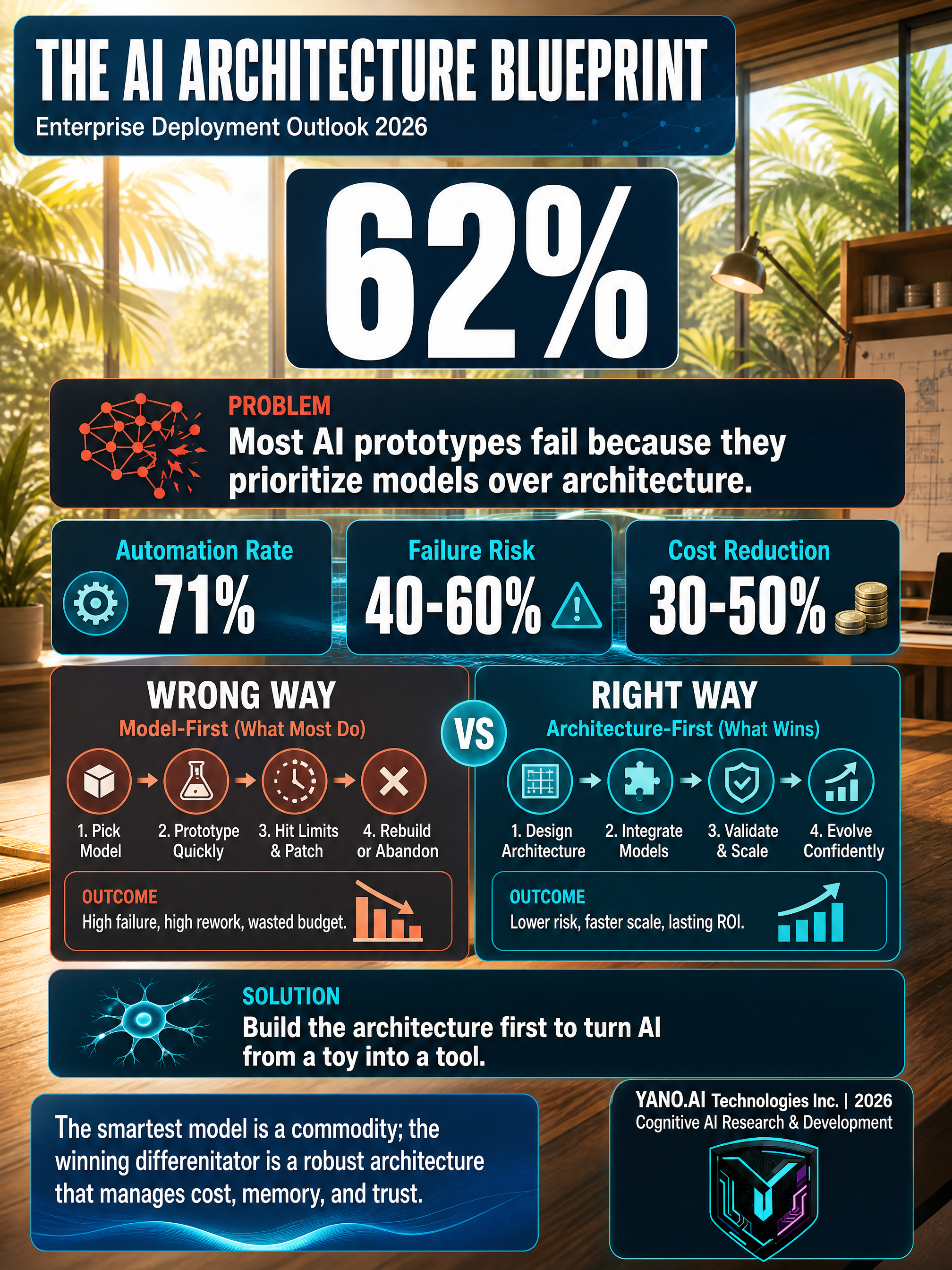
Last quarter, a regional logistics company in Cebu replaced a 14-person customer service shift with a single orchestrated agent stack. By month three, the agents were handling 71% of inbound tickets, escalating only edge cases to humans, and routing refunds through a model that decided, on its own, which payment rail to use. The call center's headcount stayed. What changed was the architecture underneath.
Welcome to the part of the AI build that nobody screenshots: the orchestration layer, the model router, the memory fabric, and the trust boundary. These are the pieces determining whether an AI product feels like a co-worker or a slot machine. They are also the parts boards fund and engineers fight over.
Why Architecture, Not Models, Is Now the Differentiator
By the end of 2026, an estimated 62% of enterprise AI deployments will fail past the prototype stage because of architectural choices made in week one, not model selection in week twelve (Source: Gartner, 2025). The capability gap between foundation models has narrowed sharply. The cost of running them has not. The companies shipping durable AI products in 2026 are the ones who stopped obsessing over benchmarks and started treating inference cost, latency budgets, and failover paths as first-class product concerns.
A model is an ingredient. An architecture is a recipe. Recipes survive when the grocery store shelves change.
What the New Stack Looks Like
The shape of a production AI system in 2026 looks very different from the chatbots of 2023. Four layers quietly dominate the conversation among the builders shipping at scale.
The Router Layer
Every serious deployment uses some form of model routing today. A prompt arrives, gets classified by cost and intent, then dispatches to a small local model, a mid-tier API, or a frontier reasoning model depending on the budget per request. Anthropic's published enterprise guidance recommends exactly this tiered approach (Source: Anthropic, 2025). The result is straightforward: a 40-60% reduction in token cost on workloads that mix routine and complex queries, with latency held flat on the routine side.
The Memory Fabric
Agents that forget everything between turns are toys. Agents that remember everything are lawsuits. The middle path is a memory fabric: short-term context windows, a vector store for semantic recall, and a structured store for facts that need to persist across sessions and users. Memory is where retrieval-augmented generation, episodic logs, and identity-aware access controls collide. Most privacy incidents in AI so far originated at this seam, not at the model itself (Source: NIST AI Risk Management Framework Update, 2024).
The Orchestration Plane
This is the layer LangChain, LlamaIndex, Temporal, Inngest, and a dozen custom internal frameworks compete over. The orchestration plane handles tool calls, retries, human approval gates, and the state machine that walks an agent from "user input" to "completed task." Without it, agents are clever demos that collapse under production traffic.
The Trust Boundary
Every input gets filtered, every output gets logged, every tool call gets a permission scope. PCI, HIPAA, and the EU AI Act have made observability a hard requirement, not a nice-to-have. The builders winning procurement in 2026 treat trust as architecture, not as a post-hoc audit trail (Source: McKinsey, 2025).
Where Philippine and SEA Builders Are Converging
In Southeast Asia, three pressures are reshaping the architectural conversation faster than in Silicon Valley.
Bandwidth is the first. A meaningful share of users are still on 3G and 4G networks in the provinces, and on metered data abroad. Architectures that ship a 12-billion-parameter model call on every turn do not survive contact with that user. Edge-deployed small models, device-side caches, and aggressive prompt compression are not buzzwords here. They are the only way a product ships (Source: World Bank Digital Progress and Trends Report, 2025).
Regulatory fragmentation is the second. Singapore's AI Verify framework, the Philippines' emerging AI guidance from the Department of Trade and Industry, and Thailand's PDPA all say slightly different things about model cards, audit logs, and data residency. A multi-country deployment needs an architecture that lets one team swap jurisdictions without rewriting the agent layer.
Cost discipline is the third. Run-rate AI inference in regional production environments routinely eats 30-50% of product margin when left unmanaged. Founders who survived 2024 did so by routing aggressively, caching prompts, batching at the queue layer, and refusing to send every user to the most expensive model. The discipline those founders built is now the default playbook.
The Trap Most Teams Still Fall Into
The most common 2026 mistake is treating the model as the product. Teams pick a frontier model, build a thin wrapper, and call it an AI company. Six months later they discover their margin is gone, their latency is unworkable on mobile, and they cannot explain to a regulator why the agent did what it did.
The teams that ship well invert the priority. They pick the workflow first, define the latency and cost ceiling, then design the architecture that fits. The model becomes the easiest decision in the stack, not the hardest.
This inversion is the single biggest factor separating the AI companies raising Series B in 2026 from the ones quietly shutting down their consumer products.
FAQ
Q: Do I need a frontier model to ship a serious AI product in 2026?
A: No. The capability curve has flattened across top-tier models for most enterprise workloads. Tiered routing between small and large models almost always beats a single-model deployment on cost and often matches it on quality (Source: Anthropic, 2025).
Q: What is the single most underrated architectural decision for a new agent product?
A: The memory layer. How an agent remembers, forgets, and is allowed to recall across sessions determines most of the user experience, most of the privacy risk, and a large share of the bill.
Q: How long does it take to build a production-grade orchestration layer from scratch?
A: For a focused single-agent workflow, 4-8 weeks. For a multi-agent system with tool use, identity, and audit, plan 4-6 months including hardening. Third-party orchestrators can cut that by half but introduce vendor risk (Source: a16z Enterprise AI Architecture Survey, 2025).
Key Takeaway
The AI products winning in 2026 are not the ones with the smartest model. They are the ones with the cleanest architecture underneath: routing that respects the budget, memory that respects the user, orchestration that respects the workflow, and a trust boundary that respects the regulator. Build the architecture first and the model becomes a commodity. Build the model first and the architecture becomes a debt you cannot pay off.
If you are a founder about to lock in your AI architecture for the next 24 months, the question worth sitting with is this: are you buying a capability, or are you buying a constraint?
Sources
Sources — external references open in a new tab.