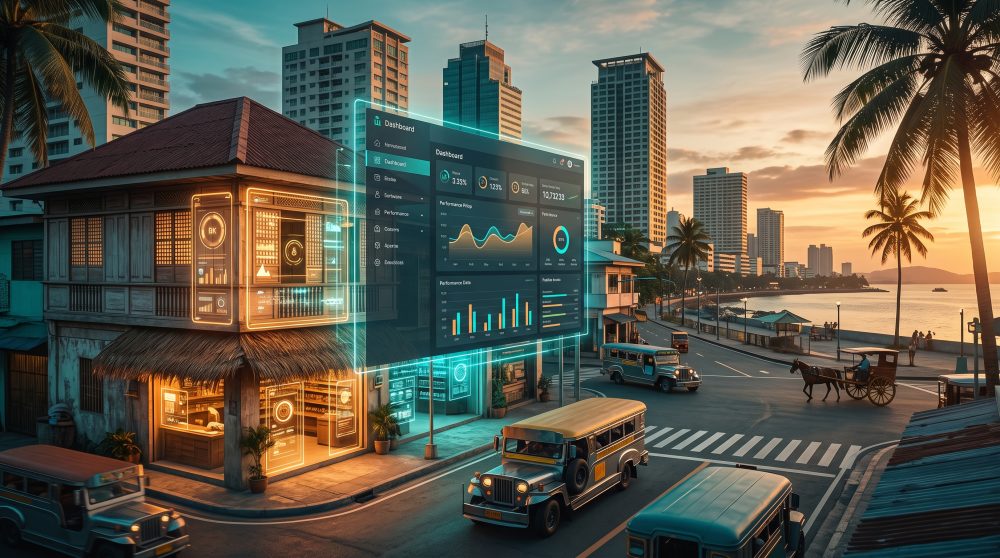
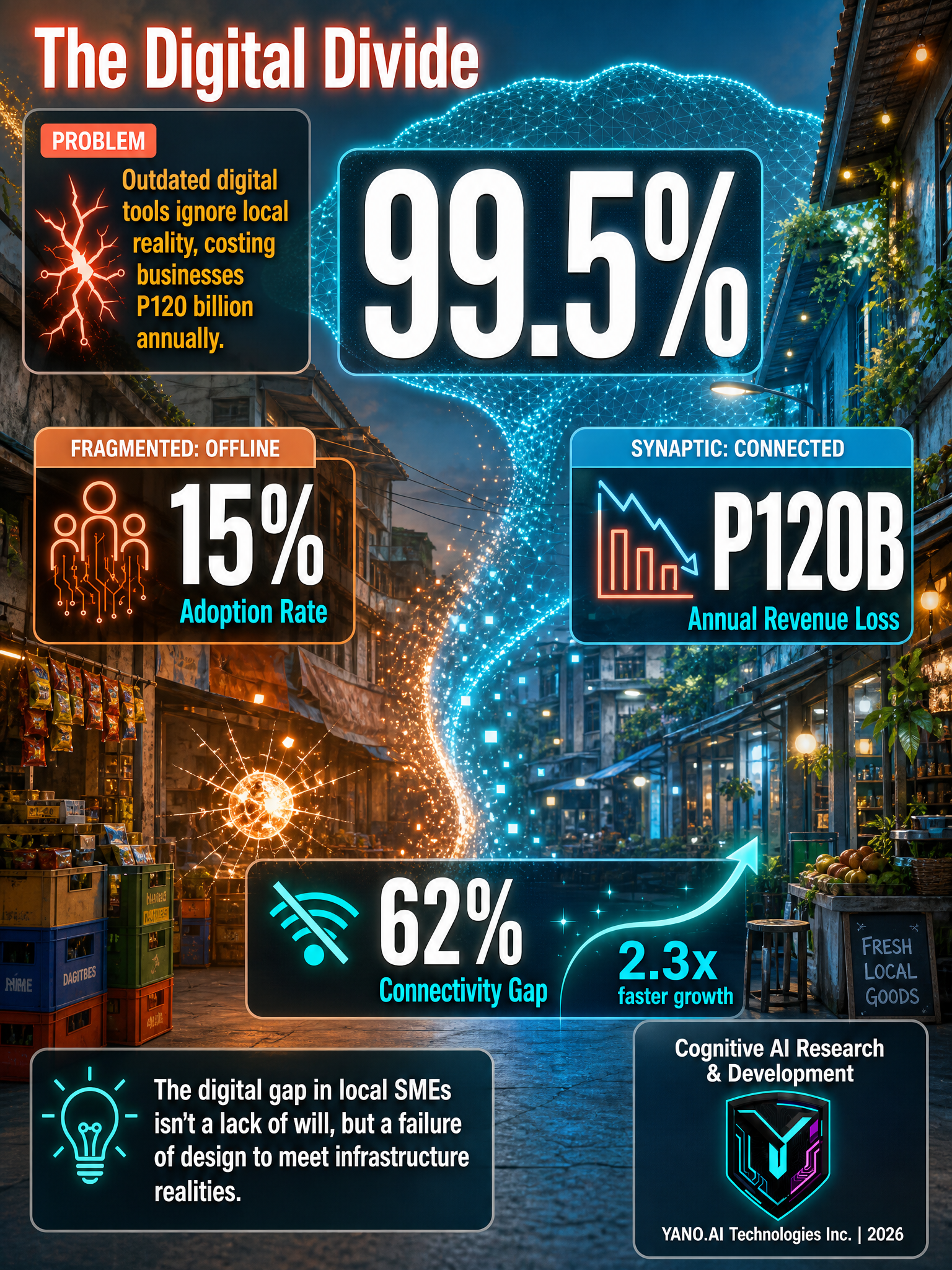
Micro, small and medium enterprises make up 99.5 percent of all registered businesses in the Philippines, yet only 15 percent have adopted any digital tools for sales, inventory, or customer management. (Source: Asian Development Bank, 2025) That gap is not a technology problem, it is an access problem, and it is costing Filipino businesses an estimated P120 billion in annual revenue. (Source: Department of Trade and Industry, 2025)
Most Filipino entrepreneurs are not choosing to stay offline because they prefer cash registers and paper ledgers. They are staying offline because digital tools feel designed for companies that do not exist in the Philippines. A point-of-sale app priced in US dollars makes no sense to a sari-sari store owner who clears less than P5,000 a day. A subscription model requiring monthly card payments alienates microenterprises where cash flow is managed week by week, not month by month. (Source: Gojek, 2024) The products were built for different markets, and Filipino SMEs have been left to patch together whatever works.
The Hardware Problem Is Worse Than the Software Problem
Many discussions about digital adoption skip over the physical layer because it is less exciting than software platforms. The reality is that 62 percent of Filipino SMEs still operate from locations with unreliable internet connectivity. (Source: IT and Business Process Association of the Philippines, 2025) Even when a business owner finds a suitable digital tool, using it requires a stable connection, a working device, and the electricity to power both.
Pre-owned smartphones are available at low prices in local markets, but mobile data packages remain out of reach for operators running on thin margins. The average Filipino microenterprise spends less than P1,000 per month on operational overhead. Asking that operator to add a data plan on top of that asks something they cannot afford. (Source: Bangko Sentral ng Pilipinas, 2025) Until connectivity costs come down, digital tools will remain aspirational rather than practical for the majority of small business owners.
What Offline-First Design Actually Means
A growing number of local and regional software teams are beginning to understand that offline-first is not a feature, it is the starting point for Philippine market fit. Applications that store data locally on a device and sync to the cloud only when a connection becomes available allow small businesses to record transactions during the day and push updates when they return home to Wi-Fi. (Source: McKinsey Southeast Asia, 2025)
This approach is not new in other markets, but it is still uncommon among the global software platforms that try to serve the Philippines. Local startups building inventory and payment tools for small businesses report that offline capability is the single most requested feature from their users. (Source: e-Philippines Startup Foundation, 2025) When software is built around the actual constraints of a specific market rather than assumed infrastructure, adoption rates improve significantly.
Government Programs Are Moving, But Not Fast Enough
The Philippine government has launched several digitalization initiatives aimed at small businesses in recent years. The Micro, Small and Medium Enterprise Development (MSMED) Council offers subsidized training and grants for digital tool adoption. (Source: DTIs MSMED Council, 2025) The problem is not the absence of programs, it is that awareness and access remain uneven across regions and business types.
Only 18 percent of microenterprise owners in rural areas are aware of any government digitalization support. (Source: Philippine Statistics Authority, 2025) Among those who are aware, 41 percent say the application process is too complex for someone without formal business training. This gap between policy and reach means that the businesses that need support the most are the ones least likely to find it. A simplified application process and mobile-first enrollment could narrow that gap without requiring additional budget.
What Filipino MSMEs Actually Need Right Now
The digital tools flooding Southeast Asian markets were not built for the Filipino sari-sari store, the neighborhood carinderia, or the online reseller working from home. What these operators need are tools that acknowledge the constraints of their environment: offline data storage, zero monthly fees or pay-as-you-go pricing, support for cash and QR transactions side by side, and interfaces in the primary local languages rather than English only.
Companies building tools for the Philippine SME market do not need to guess at these requirements. The data on what businesses actually need has been available for years. The question is whether enough builders are paying attention. (Source: World Bank Enterprise Surveys, 2025)
FAQ
Q: Are there free digital tools available for Filipino small businesses today?
Yes, several platforms including mobile-first accounting apps and government-supported marketplaces offer free or subsidized entry tiers. The challenge is finding tools built for local business types rather than generic small business categories.
Q: Does my microenterprise really need digital tools to compete?
Not necessarily, but the gap between digital and non-digital businesses is widening. A 2024 survey found that digitally enabled small businesses in the Philippines experienced 2.3 times faster revenue growth than those operating entirely offline. (Source: Gojek, 2024)
Q: What is the biggest barrier for Filipino SMEs going digital?
Unreliable internet connectivity and tools that assume constant online access remain the top barriers, followed by subscription costs that exceed the monthly budgets of microenterprises. (Source: IT and Business Process Association of the Philippines, 2025)
Key Takeaway
The Philippines has one of the highest concentrations of small businesses in Southeast Asia, and most of those businesses are operating without the digital tools that their counterparts in other countries take for granted. The gap between potential and current performance is not a technology problem — it is a design problem, an access problem, and an awareness problem. Builders who solve for the actual constraints of the Philippine market — offline-first design, local-language interfaces, pay-as-you-go pricing — will capture a segment that global platforms have consistently overlooked. The question is not whether Filipino SMEs will go digital, it is who will build the tools they will actually use.
Sources
- Asian Development Bank — SME Digitalization in the Philippines
- Department of Trade and Industry — MSMED Council
- Gojek — The State of Microbusinesses in Southeast Asia
- IT and Business Process Association of the Philippines (IBPAP) — Industry Report 2025
- Bangko Sentral ng Pilipinas — Financial Inclusion Report 2025
- McKinsey Southeast Asia — Digital Economy Report
- e-Philippines Startup Foundation — Startup Ecosystem Report 2025
- World Bank Enterprise Surveys — Philippines
- Philippine Statistics Authority — MSME Survey 2025
{"date": "2026-07-01", "domain": "sme-ph", "article_ready": true}
Sources — external references open in a new tab.