By 2027, 70% of enterprise AI architectures will require purpose-built observability layers to remain operable - up from less than 15% in early 2025. Most teams are still deploying models the way they deployed web apps in 2014, and the gap is about to show up in production bills, hallucinations, and regulator inboxes.
The Architecture That Looks Fine Until It Doesn't
A model that scored 0.94 on your eval set can quietly drop to 0.71 the moment your upstream data pipeline changes a join order. Traditional APM tools were built for deterministic services: HTTP 500 means something broke, latency p99 means a queue is full. LLM systems break in non-deterministic ways. The same prompt can return a confident, useful answer at 9 AM and a polite hallucination at 3 PM, and your dashboards will still show green.
This is why IBM's 2026 observability outlook names AI-native telemetry as the single biggest shift infrastructure teams will face this year (Source: IBM, 2026). The instruments that worked for microservices do not map onto retrieval pipelines, embedding drift, or token-level cost regressions.
What AI-Native Observability Actually Means
There are four signals a classical stack cannot give you, and every serious AI architecture in 2026 treats them as first-class.
Prompt and response lineage. Every output should be traceable back to the exact prompt template, retrieval context, model version, and tool calls that produced it. Without lineage, postmortems become guesswork.
Embedding and retrieval drift. Vector indexes age. As your source corpus shifts, the same query returns different documents, and the model starts answering a different question than the one your users think they asked.
Token economics in real time. Cost per request can swing 40x depending on prompt length, retrieval depth, and model choice. A single runaway agent loop can burn a quarterly budget in an afternoon.
Confidence and refusal rates. Calibration matters more than accuracy for production systems. A model that knows when it does not know is worth ten models that bluff.
LogicMonitor's 2026 SRE Report found that 62% of platform teams now treat AI workloads as a separate reliability domain, with dedicated on-call rotations and runbooks (Source: LogicMonitor, 2026). That is a structural change, not a tooling upgrade.
The Reference Architecture
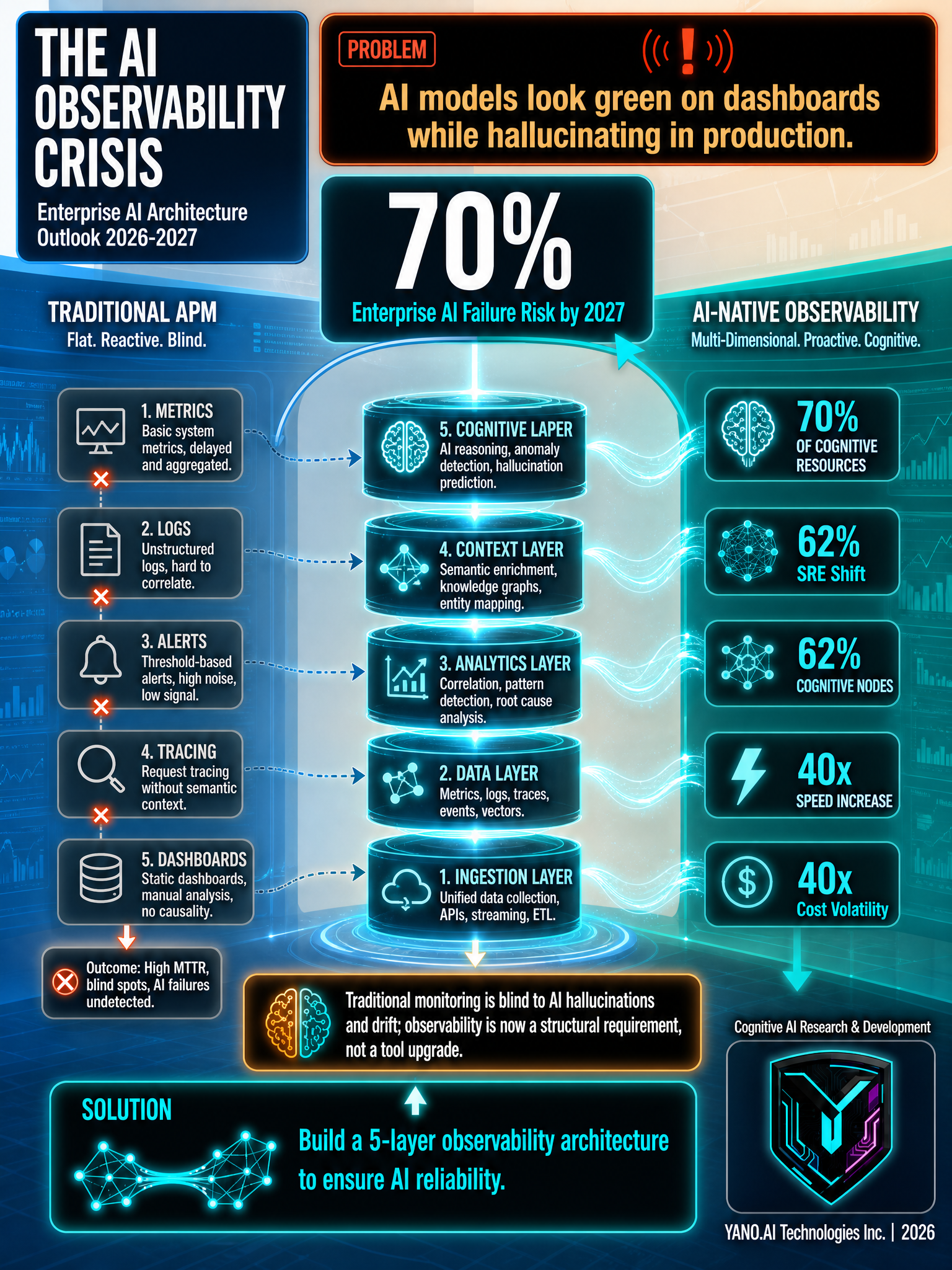
The pattern that keeps showing up across mature AI deployments has five layers, and observability is not bolted on at the end.
Layer 1: Data and Retrieval
Every chunk, every embedding, every retrieval result gets an ID and a timestamp. Store them. You will need them when a regulator asks why your chatbot told a customer the wrong policy clause.
Layer 2: Model Gateway
One chokepoint for every inference call. Tag every request with user ID, tenant, feature flag, model version, and prompt hash. This is where cost, latency, and quality metrics become attributable instead of averaged.
Layer 3: Evaluation Harness in Production
Offline evals are necessary but not sufficient. Shadow scoring, LLM-as-judge on samples, and human-in-the-loop review on edge cases need to run continuously, not quarterly.
Layer 4: Agent and Tool Tracing
If you have agents calling tools, you need a trace format that captures the full reasoning chain. OpenTelemetry is extending its semantic conventions for this exact use case, and the early adopters are pulling ahead (Source: OpenObserve, 2026).
Layer 5: Feedback Loop
Production traces feed back into eval sets, which feed back into fine-tuning data, which feed back into the gateway. The loop closes or it does not. Most teams stop at Layer 3 and wonder why their models are getting worse.
Where Filipino AI Teams Are Spending Their Budget
Local deployments are following the same arc, just 12 to 18 months behind the US frontier. BPO-adjacent AI products for customer support, document processing, and voice analytics are the most common entry points, and they hit the same walls the moment they leave pilot.
Converge ICT and a handful of large enterprises have started building internal model gateways rather than letting business units call OpenAI or Anthropic directly. The motivation is governance, not cost, but the cost numbers tend to follow once finance sees the per-tenant breakdown. A unified gateway is also the only realistic way to enforce data residency, which matters more every quarter as the National Privacy Commission tightens guidance on cross-border inference.
The teams winning in 2026 are not the ones with the best models. They are the ones who can answer, in under five minutes, why a specific user got a specific answer at a specific time.
FAQ
Q: Is traditional APM enough for LLM systems?
A: No. APM catches infrastructure failures; it misses prompt regressions, retrieval drift, and hallucination patterns. You need AI-native signals layered on top.
Q: What is the minimum viable observability stack for an AI product?
A: A model gateway with request tagging, a tracing system that captures prompt and retrieval context, and a production eval harness sampling 1 to 5% of traffic.
Q: How much should we budget for observability in an AI project?
A: Plan for 12 to 18% of total AI infrastructure spend. Teams that skip this line item end up paying it back in incident response and model rework.
Q: Can open-source tools handle this, or do we need a vendor?
A: The open-source stack (OpenTelemetry, Langfuse, Phoenix, Grafana) is genuinely good in 2026. Vendors add convenience and SLAs, but the foundation is solid.
Key Takeaway
The teams shipping reliable AI in 2026 treat observability as part of the architecture, not a finishing touch. Every model call is a hypothesis you can test, every retrieval is a data point you can audit, and every agent step is a failure mode you can trace. The question is not whether you can afford to build this layer. It is whether you can afford to ship without it.
What is the first observability signal you would add to your AI stack this quarter?
Sources
Sources — external references open in a new tab.