
By Yano.AI Research | June 25, 2026
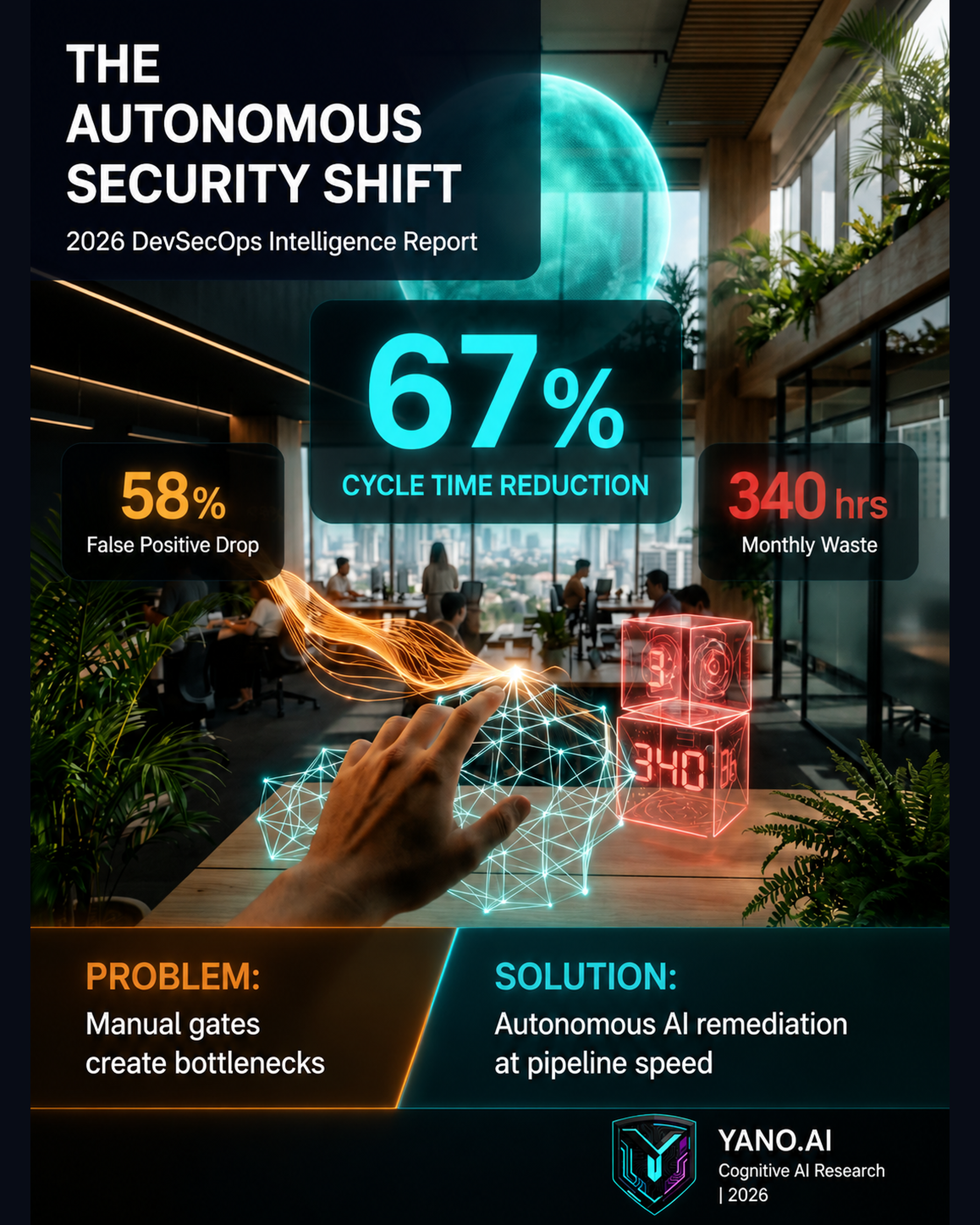
Last quarter, a mid-sized Philippine fintech company tried something most security teams would consider reckless: they let an AI agent approve its own code merges after a successful static scan. No human gatekeeper. No ticket queue. The result was a 67% reduction in deployment cycle time — and within six weeks, the same agent caught a critical SQL injection flaw that a manual review had missed three times.
This is what AI-driven DevSecOps looks like when it works. It's also what makes security leaders lose sleep.
The Old Model Is Breaking Down
Traditional DevSecOps works like a toll booth. Code enters a pipeline, security tools scan it, and a human decides whether to let it through. The problem isn't that this process fails — it's that it can't scale. Gartner estimates that by end of 2026, 40% of enterprise applications will integrate task-specific AI agents — up from less than 5% today. That's not a gradual shift. It's an inflection point, and most security architectures were built for the world that existed before it.
In 2025, enterprise security teams using legacy CI/CD-integrated SAST (Static Application Security Testing) tools reported an average of 340 hours per month spent on false positive triage. That's nearly nine full workweeks of engineer time — consumed not by fixing vulnerabilities, but by determining whether vulnerabilities were real.
The math is simple: humans cannot keep up with the speed of AI-accelerated development pipelines.
From "Shift Left" to "Agents Everywhere"
The industry response to this problem was "shift left" — move security checks earlier in the development lifecycle. That was the right instinct, but the execution stalled. Shifting left without intelligence just means finding problems earlier in a pipeline that still moves at the same human speed.
The new model is different. AI-driven DevSecOps doesn't just move security earlier — it makes security checks autonomous, context-aware, and continuous.
Consider ML-SAST (Machine Learning-based Static Application Security Testing), which GoDaddy reported using to reduce false positive rates by 58% compared to traditional rule-based scanners. Instead of flagging every instance of a dangerous function call, ML models understand code context: whether a variable is user-controlled, whether sanitization happens before or after a database query, whether the call path actually reaches a user-facing endpoint.
This is the difference between a smoke detector that screams every time you boil water and one that understands the difference between a kitchen fire and dinner.
The Rise of Autonomous Security Agents
The next layer of this shift is what Gartner calls Autonomous Security Agents — AI systems that don't just identify vulnerabilities but actively remediate them. This goes beyond automated patch generation. We're talking about agents that can:
- Rewrite unsafe code segments with safe alternatives
- Automatically generate and test compensating controls when direct patches aren't feasible
- Coordinate across SCA (Software Composition Analysis) and SAST outputs to assess real-time compound risk from dependency chains
Checkmarx's 2026 AppSec report found that 71% of organizations now run more than 1,000 open-source dependencies per application. No human security team can manually track every CVE across that surface area. AI agents operating continuous SCA can — and they're doing it at pipeline speed.
The Skill Gap Nobody Talks About
There's a uncomfortable reality buried in the excitement around AI-driven DevSecOps: most security professionals aren't ready for it. A 2026 survey by Infosec Train found that 68% of security engineers describe their current skill set as "focused on single-tool operations" — running a SAST scanner here, a DAST tool there, interpreting results manually.
That skill model is becoming obsolete. The new demand is for security professionals who can design, orchestrate, and audit multi-agent security workflows — understanding not just what each agent does, but how they coordinate, where they fail, and what happens when they disagree.
In the Philippines, this gap has a local dimension. The Bangko Sentral ng Pilipinas (BSP) has accelerated its open banking framework requirements, pushing more Philippine financial institutions toward API-first architectures with embedded security requirements. Security teams at BDO, UnionBank, and emerging digital banks like Maya Business are now competing for the same pool of DevSecOps talent — talent that largely doesn't exist yet in sufficient quantities locally.
BDO's cybersecurity division reportedly spent ₱23 million in 2025 on upskilling programs specifically targeting AI-assisted security operations, according to industry sources. That's not a luxury. It's an admission that the talent pipeline hasn't caught up to the technology.
What This Means for Your Pipeline Today
You don't need to deploy autonomous security agents tomorrow. But if your CI/CD pipeline still treats security as a final gate rather than a continuous, intelligence-augmented process, you're already falling behind.
The practical starting point is narrower than it sounds: choose one pain point — false positive fatigue, CVE response time, or manual SAST triage — and instrument AI to address that specific problem. Measure. Then expand.
Microsoft's Security Copilot and GitHub Advanced Security have already demonstrated that AI-assisted code review can reduce security debt accumulation by identifying issues at the commit level, not the release level. The question isn't whether this works. It's whether your team has the orchestration literacy to make it work without creating new failure modes.
Is your security pipeline built for AI-accelerated development — or is it still optimized for the world before agents?
References
- Gartner, "Emerging Tech: AI-Driven DevSecOps Integration," 2026
- Checkmarx, "Application Security Trends in 2026," 2026
- Infosec Train, "AI Cybersecurity Roadmap for 2026," May 2026
- GoDaddy Engineering Blog, "ML-SAST Implementation Results," Q1 2026
- Bangko Sentral ng Pilipinas, "Open Banking Framework Circular," 2025
- BSP Financial Stability Report, 2025
📋 PRISM Content | yanoai.tech | dev.to/yanoai
Sources — external references open in a new tab.