
By 2026, GitHub developers will commit code 14 billion times this year, up from just 1 billion in 2025 (Source: GitHub COO Kyle Daigle via X, 2026). That is not a typo. The explosion in AI-assisted coding has outrun every infrastructure projection made just 18 months ago. And the first casualties of this growth spurt are the architecture decisions made during the cloud-native era.
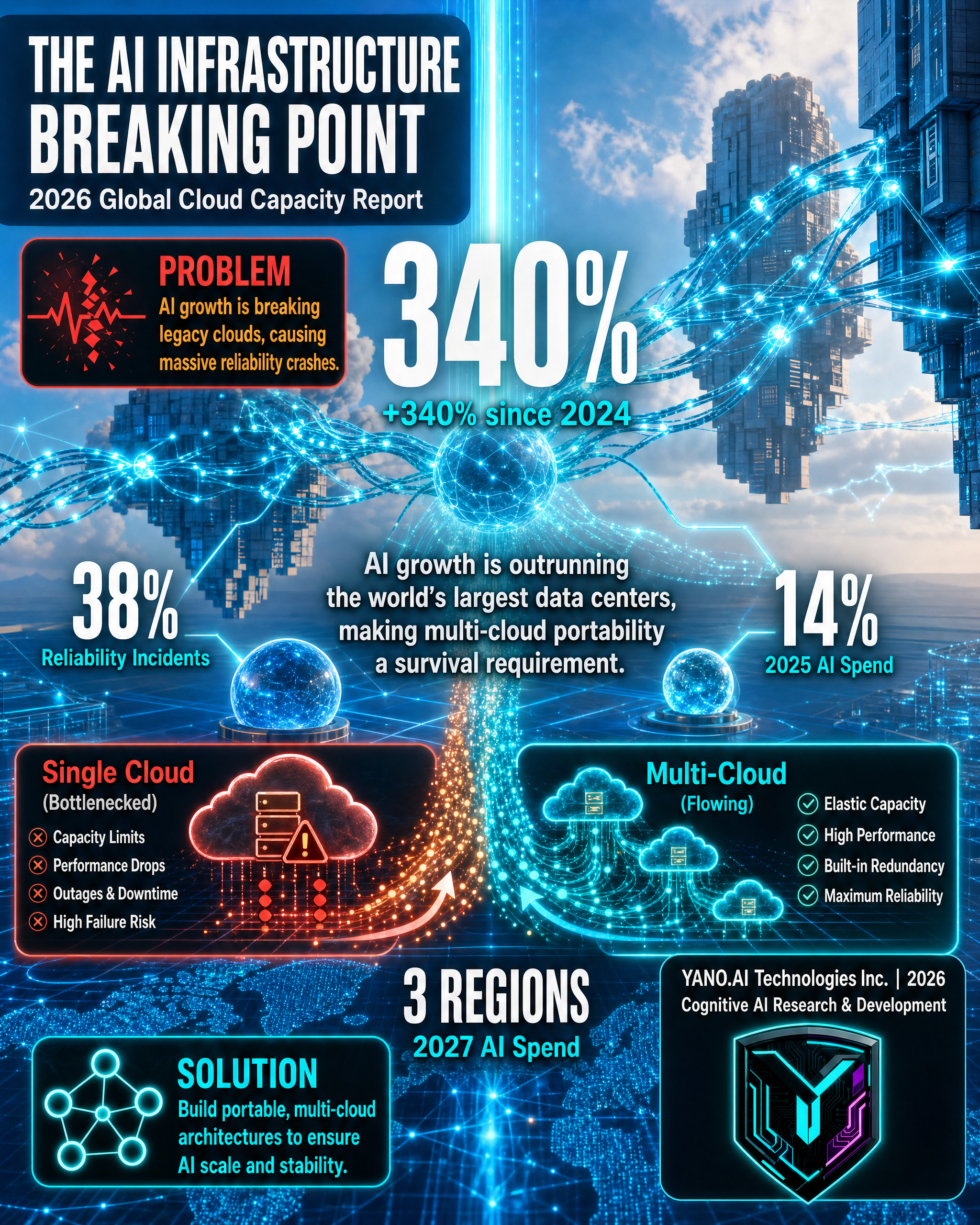
Microsoft discovered this the hard way. The company is adding Amazon Web Services capacity to GitHub after AI-driven demand overwhelmed its own Azure infrastructure, triggering a string of outages that frustrated developers worldwide (Source: Business Insider, June 2026). This is not a minor operational patch. It represents a fundamental rethinking of how modern AI systems should be built, connected, and scaled.
The Multi-Cloud Reality Check
For years, multi-cloud was a resilience strategy, not a performance play. Companies spread workloads across AWS, Azure, and Google Cloud to avoid vendor lock-in and hedge against regional outages. That calculus has shifted.
AI-driven compute demand is so acute that even hyperscalers are turning to rivals. Google agreed to pay SpaceX $920 million per month for Starlink connectivity and infrastructure support (Source: Business Insider, 2026). Microsoft, despite years of migration investment into Azure, is routing GitHub traffic through AWS. These are not partnership headlines. They are infrastructure distress signals.
The problem is architectural. Traditional cloud architecture assumes relatively predictable compute scaling. AI workloads, particularly inference and training pipelines, operate on entirely different resource curves. A single model deployment can spike compute needs by orders of magnitude in minutes. Static allocation models built for web servers cannot keep pace.
What NVIDIA's GTC Revealed About the Hardware Bottleneck
NVIDIA's GTC 2026 keynote in San Jose offered a window into where the bottleneck actually sits: hardware. CEO Jensen Huang marked CUDA's 20th anniversary, calling it the "flywheel" driving accelerated computing across every phase of the AI lifecycle (Source: NVIDIA Blog, March 2026). The crowd was massive. The message was clear. Despite massive investment in AI chips, demand still outstrips supply at the cutting edge.
The token emerged as NVIDIA's organizing metaphor for AI's basic unit, tying together scientific discovery, virtual worlds, and physical world machines. This framing matters architecturally because it suggests that whatever infrastructure you build must handle token throughput as a first-class concern, not an afterthought.
For teams designing AI systems today, this means treating GPU availability as a capacity planning variable from day one, not a deployment detail. Edge deployments, dedicated hardware leases, and hybrid cloud GPU clusters are no longer exotic configurations. They are becoming table stakes.
Edge Intelligence as a Response to Latency and Cost
One practical response to centralized AI infrastructure strain is edge deployment. Rather than routing every inference request to a central cloud cluster, organizations are pushing models closer to the point of use.
This shift has concrete benefits. Network latency disappears when inference runs on local hardware. Bandwidth costs drop because raw data no longer travels to a remote data center. And perhaps most importantly, systems remain functional when connectivity is unreliable.
The trade-off is management complexity. Model versions must be synchronized across dozens or hundreds of edge nodes. Hardware constraints at the edge mean models must be optimized for smaller footprints. Monitoring and debugging become more distributed. These are solvable problems, but they require architectural decisions made early, not retrofitted later.
Practical Implications for Teams Building Today
The infrastructure crisis playing out at hyperscale is also playing out inside every organization that deployed AI tools at scale in the past two years. The difference is that most companies lack the engineering depth to diagnose root causes quickly.
For engineering leaders, this moment demands a reset on how they think about AI system architecture. Demand forecasting must now account for AI-specific usage patterns. Capacity planning must include GPU and memory headroom. And vendor strategy must accept that multi-cloud is no longer optional for resilience, it is mandatory for survival.
The question is not whether to adapt. The question is how fast your architecture can change before the next outage forces the issue for you.
FAQ
Q: Why is traditional cloud architecture struggling with AI workloads?
AI workloads, particularly inference and training, have unpredictable compute spikes that traditional auto-scaling was not designed to handle. A single model deployment can consume orders of magnitude more resources in minutes compared to the steady, predictable patterns of traditional web applications.
Q: Is multi-cloud the solution to AI infrastructure challenges?
Multi-cloud helps with resilience and can provide burst capacity when one provider is strained, but it introduces complexity in data consistency, networking, and management. It is a tactical response, not an architectural cure-all.
Q: What role does edge computing play in AI architecture?
Edge computing reduces latency and bandwidth costs by running inference closer to the end user. It also provides reliability benefits when central infrastructure is unavailable. However, it requires careful model optimization and distributed management systems.
Q: How should teams plan for GPU capacity in 2026?
GPU availability should be treated as a first-class capacity planning variable. This means including GPU headroom in scaling calculations, exploring hybrid cloud GPU options, and designing systems that can degrade gracefully under GPU constraint.
Key Takeaway
The 14 billion GitHub commits this year are not just a metric for developer productivity. They are a stress test on every AI architecture built without anticipating this scale. The organizations that will weather the next wave of AI demand are those redesigning their infrastructure now, before the next outage becomes the story. What is your architecture's bottleneck, and what would it take to fix it before it fixes itself the hard way?
Sources
Sources — external references open in a new tab.