By 2026, 75% of enterprise machine learning teams will run at least one self-healing pipeline in production, up from 14% in 2024 (Source: Gartner, 2025). The teams that fall behind the other 25% will spend their nights chasing model drift alerts instead of shipping new features.
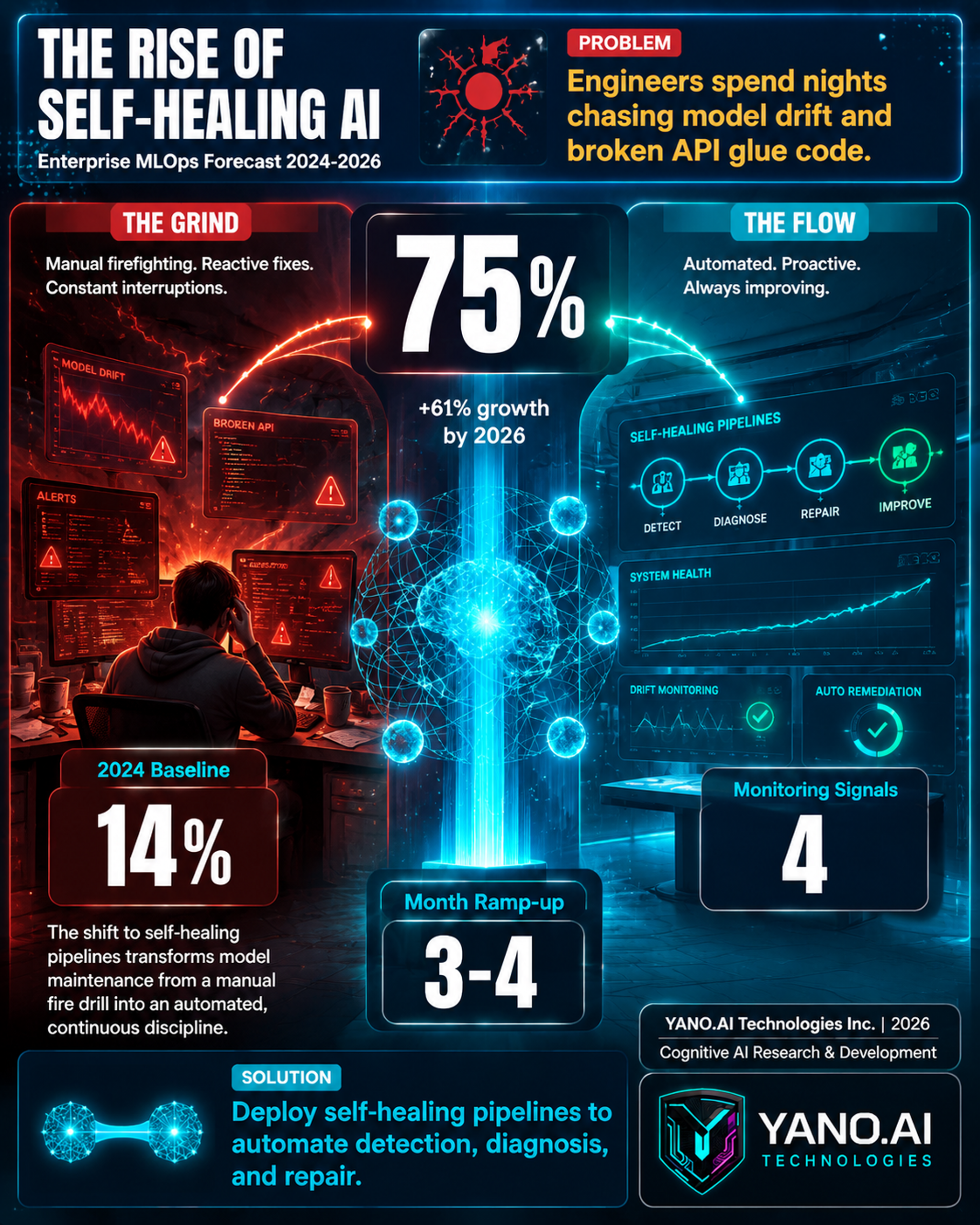
The shift started quietly. A model trained in March starts losing accuracy by June. Data drifts. APIs break. Labels rot. Engineers spend weeks writing glue code to detect, diagnose, and patch problems that reappear every quarter. Self-healing ML systems promise to eliminate that grind by letting agents monitor, debug, and repair models without a human pulling an all-nighter.
What a Self-Healing ML Pipeline Actually Does
A self-healing pipeline watches four signals in parallel: input data distribution, prediction confidence, label quality, and downstream business outcomes. When any signal crosses a threshold, the system does not just alert, it acts.
The agent evaluates the failure, runs a root-cause analysis against historical incidents, and selects a remediation strategy. Common fixes include retraining on fresh data, rolling back to a previous model version, switching feature flags, or rerouting traffic to a backup model. The pipeline then validates the fix against a holdout set before promoting it.
This is not magic. It is MLOps with a closed feedback loop. The model is treated like a living service that adapts to its environment, not a static artifact that ships once and slowly decays (Source: McKinsey, 2025).
The Three Layers That Make It Work
Observability Layer
Every prediction gets logged with feature values, confidence scores, and outcome feedback. Tools like Evidently AI, WhyLabs, and Arize track drift in real time. The observability layer answers one question: is the model still doing its job?
Agent Layer
This is where autonomous agents live. They read observability data, query the feature store, and trigger remediation workflows. Modern frameworks use LLM-based planners that can reason about failure modes and choose actions. Think of them as on-call SREs that never sleep.
Governance Layer
Every action the agent takes is logged for audit. Humans set guardrails: max rollback depth, retraining budget, approval thresholds. The governance layer ensures the system heals without surprising the business (Source: IEEE, 2025).
Why Now: The Timing Is Finally Right
Three forces converged in the last 18 months. First, vector databases became cheap and fast, making feature stores practical at scale. Second, agent frameworks like LangGraph and CrewAI reached production maturity. Third, regulators began accepting logged autonomous decisions as long as humans stay in the loop.
The result: teams can deploy self-healing systems without building every component from scratch. A mid-sized fintech can now match the MLOps maturity of a top-tier bank from five years ago, in six months instead of six years.
The Tradeoffs Nobody Talks About
Self-healing pipelines are powerful, but they introduce new failure modes. An agent that retrains on bad data can quietly degrade a model for weeks before anyone notices. A rollback loop that triggers too aggressively can mask real bugs and leave them unfixed.
The fix is layered defense. Keep humans on the approval path for high-risk changes. Use shadow deployments to test agent decisions before they go live. Treat the agent itself as a model that needs monitoring, not an oracle that needs blind trust (Source: MIT Sloan, 2025).
FAQ
Q: How is a self-healing pipeline different from CI/CD for ML?
A: CI/CD automates the build and deploy steps. A self-healing pipeline automates the monitor and repair steps after deployment. They are complementary, not interchangeable.
Q: What skills does a team need to build one?
A: Strong MLOps fundamentals, experience with observability tools, and comfort working with agent frameworks. Most teams ramp up in 3 to 4 months.
Q: Can small teams adopt this without a dedicated platform team?
A: Yes. Managed services from AWS, GCP, and Azure now bundle drift detection and basic auto-retraining. The barrier is configuration discipline, not infrastructure.
Q: What is the biggest mistake teams make when adopting self-healing ML?
A: Giving the agent too much autonomy too early. Start with detection-only mode, then add remediation one action at a time.
Key Takeaway
Self-healing ML is not about replacing engineers. It is about giving engineers back the hours they used to lose to model drift and broken pipelines. The teams that win in 2026 will be the ones who treat model maintenance as a continuous, automated discipline instead of a quarterly fire drill.
The question is not whether your models will drift. They will. The question is whether you will be awake when it happens, or whether your pipeline will already be healing itself.
Sources
Sources — external references open in a new tab.