
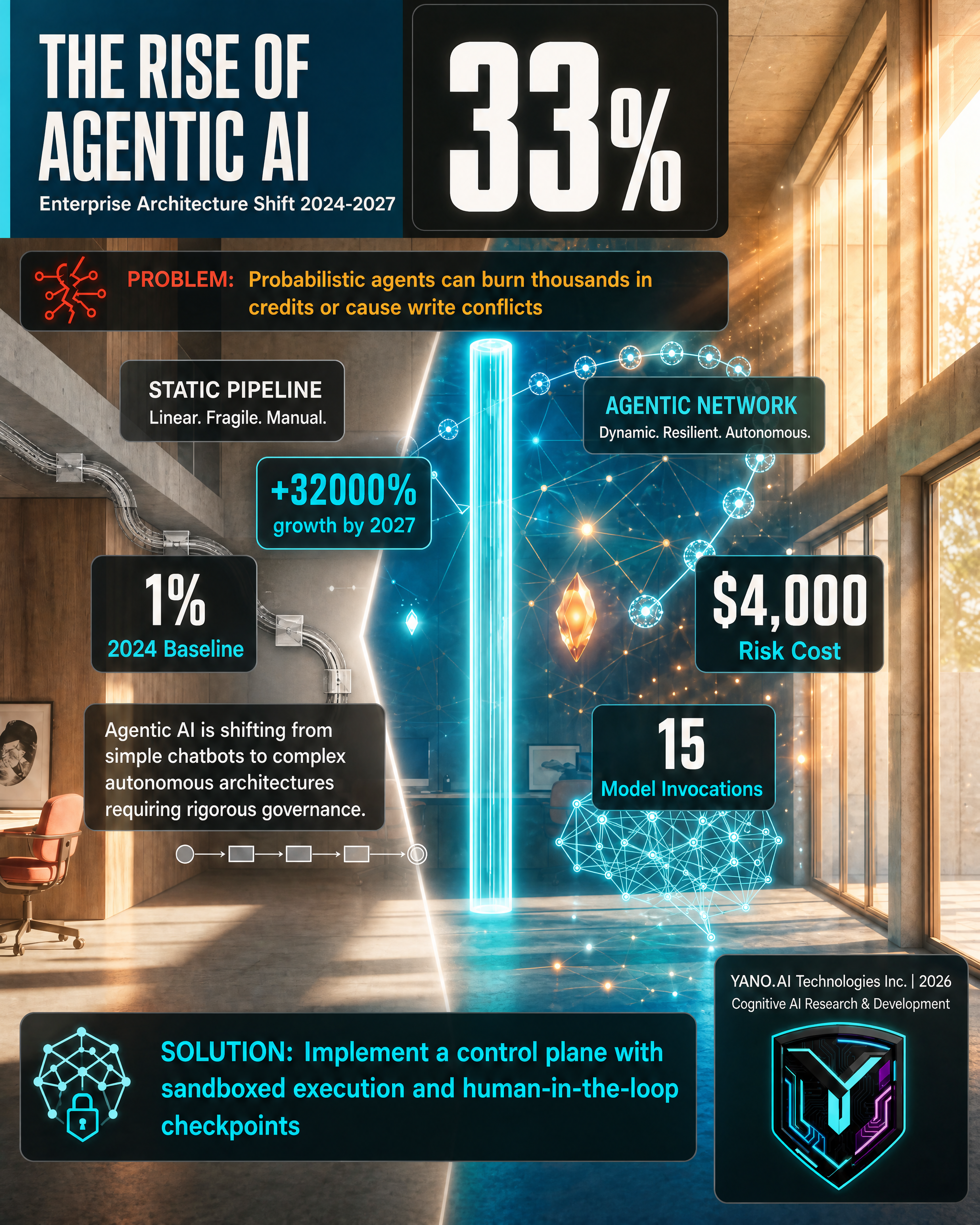
By 2027, 33% of enterprise software applications will include agentic AI capabilities - up from less than 1% in 2024 (Source: Gartner, 2025). That jump is not a forecast. It is the operational reality pulling architects away from static request-response pipelines and toward something messier, more distributed, and far more accountable: a network of agents that plan, call tools, and act on their own.
What Agentic Architecture Actually Looks Like
Most enterprises still draw their AI diagrams around a single model call wrapped in a prompt template. Agentic architecture breaks that pattern into four layers, each with its own failure modes.
The perception layer ingests signals from APIs, logs, documents, and user prompts. The planning layer decomposes goals into steps, often using a chain-of-thought loop or a planner-executor split. The action layer reaches into external systems through tool calls, function execution, and database writes. The memory layer keeps state across turns, sessions, and sometimes across agents.
In practice, this means a single user request can trigger five to fifteen model invocations, several tool calls, and a short debate between agents checking each other's work. The compute footprint looks nothing like a chatbot (Source: McKinsey, 2025).
Why Traditional Architecture Patterns Break
REST was designed for deterministic endpoints. Agentic systems are not deterministic. A planner might pick a different path on the same prompt if the world has changed in between. That breaks three assumptions enterprise architects rely on.
First, idempotency. An agent might read a file, decide to act, then re-read it before acting. If two agents race on the same record, you get a write conflict with no human in the loop to reconcile. Second, observability. A 400-millisecond request hides ten model calls, three retries, and a tool timeout. Distributed tracing was built for synchronous services, not for inference graphs that branch on token probability. Third, cost predictability. A single misconfigured agent can burn $4,000 of inference credits overnight chasing a hallucinated tool schema (Source: Anthropic, 2025).
The DevSecOps Convergence
The strongest signal in enterprise AI right now is the merger of agentic systems with security operations. Agentic AI for DevSecOps has become a top engagement driver in technical communities, with conversations about autonomous agents that scan code, APIs, and infrastructure-as-code running tens of thousands of interactions per week (Source: Checkmarx, 2026).
The pattern is consistent. A security agent reads a pull request, runs a static analyzer, queries a vulnerability database, opens a Jira ticket, and posts a Slack summary - all without a human clicking a button. By 2026, AI-driven forensics is becoming a standard part of every major SOC's toolkit (Source: SentinelOne, 2026). The architectural question is no longer whether to deploy these agents, but how to govern them when they are the first responder to a live incident.
Core Building Blocks You Need Now
Architects shipping production agentic systems in 2026 tend to standardize on a small set of primitives.
- A planner-executor split. One model reasons about the goal. A separate model - often smaller and cheaper - performs the individual tool calls. This keeps the expensive reasoning layer auditable.
- Structured tool schemas. Every tool the agent can call gets a strict JSON schema, a timeout, and a cost ceiling. Loose function-calling is how runaway bills happen.
- Sandboxed execution. Agents that write code run inside ephemeral containers with no network access by default. Capability is granted per task, not per session.
- Episodic and semantic memory. Short-term context lives in the prompt. Long-term facts live in a vector store with explicit write paths, so the agent cannot accidentally rewrite its own memory.
- Human-in-the-loop checkpoints. Not for every action, but for the irreversible ones: payments, deletions, external messages, production deploys.
The Hidden Cost: Governance
Most agentic pilots die in governance review, not in engineering. The reason is simple. When a model can act, the audit trail is no longer a log line - it is a chain of decisions, each one probabilistic.
Application Security Posture Management (ASPM) has emerged as the architectural response. ASPM platforms now serve as the central nervous system connecting code, runtime, and identity signals into a single posture view (Source: Palo Alto Networks, 2026). The same pattern is showing up in agentic AI: a control plane that records every plan, every tool call, and every outcome, then rolls them up into a posture score the CISO can read.
The teams winning this are the ones treating governance as a runtime concern, not a documentation exercise.
What This Means for the Next 12 Months
Three shifts are already visible. Cross-domain AI solutions for secure data transfer between security domains are moving from pilot to production, with the market projected to grow at a double-digit CAGR through 2030 (Source: Fortune Business Insights, 2026). Cloud-native security architectures are absorbing agentic workloads as a first-class citizen alongside serverless functions and containers (Source: Gartner, 2026). And the org chart is shifting: enterprises are hiring "AI architects" who report to platform engineering, not to data science.
The companies that treat agentic AI as an infrastructure problem - with the same rigor they apply to networking, identity, and observability - will outpace the ones that treat it as a demo.
FAQ
Q: What is the difference between an LLM app and an agentic AI system?
A: An LLM app responds to a prompt with a single inference call. An agentic system plans multi-step actions, invokes tools, observes results, and iterates - often across many model calls per user request.
Q: How do you control cost in agentic architecture?
A: Set per-tool timeouts, per-session token budgets, and route execution to smaller models when the task does not require frontier reasoning. Most teams also cap recursion depth to prevent infinite planning loops.
Q: Is agentic AI safe for production workloads?
A: It can be, but only with a control plane that records every action, sandboxes execution, and routes irreversible operations through human approval. The risk surface is wider than a traditional API, not narrower.
Q: What is ASPM and why does it matter for AI agents?
A: Application Security Posture Management unifies signals from code, runtime, and identity into a single risk view. For agentic systems, the same pattern extends to AI-specific signals like prompt injection surface and tool-call provenance.
Key Takeaway
Agentic AI is not a feature you bolt onto a chatbot. It is a new architecture pattern with its own primitives, failure modes, and governance requirements. The teams that win in 2026 will be the ones who stop asking "which model should we use" and start asking "how do we govern a probabilistic system that can take real actions on our behalf."
What is the first irreversible action you would trust an autonomous agent to take inside your organization this quarter?
Sources
Sources — external references open in a new tab.