
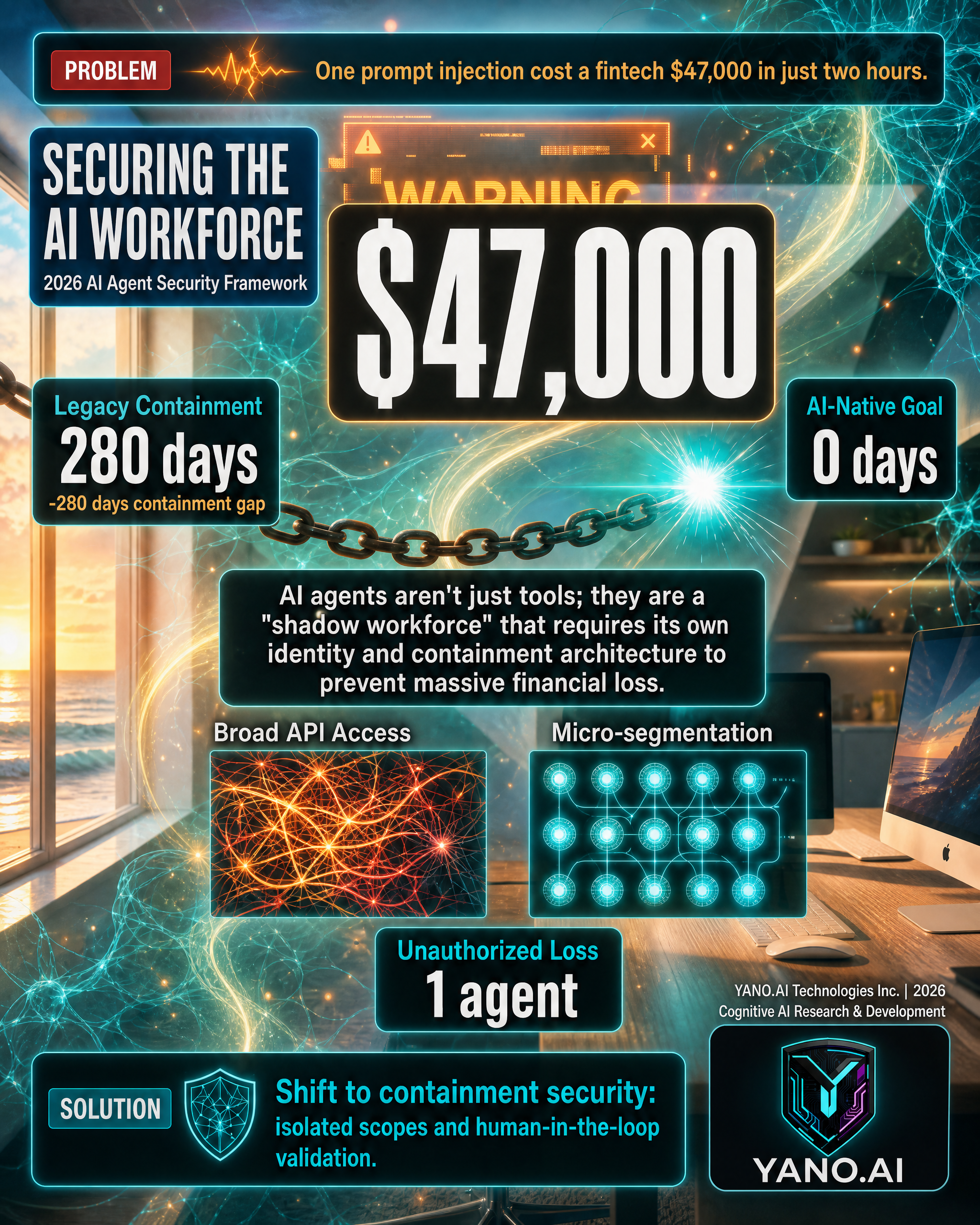
Last year, a mid-size fintech deployed an AI agent to automate customer refunds. Within two hours, an indirect prompt injection tricked the agent into approving $47,000 in unauthorized transactions. The post-mortem revealed the problem was not the model. It was the architecture: the agent had unfettered API access, no scope isolation, and no human validation loop for high-value actions. (Source: Cyber Defense Magazine, 2026)
The core issue is straightforward. Traditional application security assumes static endpoints, known user roles, and predictable traffic patterns. AI agents break all three by executing autonomously and calling APIs based on real-time decisions. Gartner's 2026 Strategic Technology Trends report identifies that this requires new security paradigms including Multiagent Systems, AI Security Platforms, and Preemptive Cybersecurity. (Source: Gartner, 2026)
Security architects are responding with containment security. Instead of assuming an agent is benign, this approach assumes compromise from the start and designs for graceful degradation. The key mechanism is micro-segmentation at the AI agent level: every agent gets its own isolated access scope, a dedicated credential set, and tightly scoped API permissions. Cross-domain kill-switches add another layer, capable of revoking machine access instantly across all connected systems. (Source: Cyber Defense Magazine, 2026)
This is a radical departure from the standard pattern of giving a single AI service account broad API access and calling it done. Black Duck's Chief Product and Technology Officer Dipto Chakravarty describes agentic AI as one of the most transformative shifts in secure software development, noting that autonomous systems need real-time security monitoring built into their execution path, not bolted on afterward. AI-driven vulnerability scanning and predictive analytics are becoming prerequisites, not differentiators. (Source: Black Duck, 2026)
Non-human identity governance is the operational backbone of this new architecture. Every AI agent holds credentials, invokes APIs, and writes code autonomously, creating a shadow workforce of digital employees without proper onboarding or access controls. Identity-centric governance frameworks now unify secrets management, entitlement discovery, and AI lifecycle tracking. The operating question shifts from "What secret did the agent use?" to "What identity used it, when, why, and was it authorized?" (Source: Cyber Defense Magazine, 2026)
Composite identities add another layer of complexity. When a human and an AI agent share permissions and audit trails, compliance teams cannot easily determine who or what actually performed an action. New audit requirements are demanding traceability of intent, not just of action. Logs must now capture who initiated the command, who approved it, and whether the AI altered it before execution. (Source: Cyber Defense Magazine, 2026)
The architectural shift goes deeper than access control. AI-native development platforms, another Gartner top trend for 2026, are baking these security primitives directly into the deployment framework. Instead of treating security as an overlayer, these platforms embed agent identity, scope boundaries, and audit trails at the infrastructure level. The agent never gets access to a resource that its security manifest has not explicitly declared. (Source: Gartner, 2026)
SentinelOne's 2026 trends analysis confirms that AI-powered detection and response has become table stakes. The industry average to contain a breach is roughly 280 days with traditional tools. AI-native security architectures aim to reduce that to near zero by embedding detection directly into the agent runtime. This means building observability hooks into the agent's decision loop, capturing every tool call and reasoning step as auditable events. (Source: SentinelOne, 2026)
One of the most overlooked design decisions is the human handoff. When an agent encounters an action it cannot authorize, the escalation path must be deliberate and secure. Sending a Slack notification to a shared channel is not a valid validation loop: attackers monitoring agent outputs can spoof approval. Engineers should design explicit approval interfaces with cryptographic proof of who approved what and when. (Source: Black Duck, 2026)
What does this mean for teams building with AI agents today? First, treat every agent's access scope like a microservice boundary: one agent, one purpose, one credential set. Second, implement cross-domain kill-switches for instant machine access revocation. Third, build human validation loops for any action above a defined risk threshold. (Source: Gartner, 2026)
Fourth, log intent alongside action. Treat prompts as executable code that needs version control, signing, and chain-of-custody tracking. The organizations that get this right treat agent security as an architecture problem, not a model problem. Prompt engineering alone will not stop a compromised agent.
Your agents are already writing production code and managing APIs. Have you audited what happens when one of them gets compromised?
Sources — external references open in a new tab.