
For years, the narrative around artificial intelligence in the enterprise centered on model capability: bigger models, better benchmarks, more tokens processed per second. But a wave of new signals from across the AI ecosystem is shifting the conversation. The consensus emerging among practitioners is that raw model performance is no longer the primary constraint. The bottleneck, increasingly, is something far more mundane: permissions.
In a May 2026 interview with TechCrunch, Cognition's Scott Wu—whose company built the AI coding agent Devin—laid out a nuanced view that challenges both the AI-doomsday crowd and the automation-utopian marketers. "AI coding agents are extraordinarily capable at executing tasks," Wu said. "But the moment you ask them to do something that requires a live system context—accessing a repository, pushing code to production, approving a deployment—they hit a wall. Not because the model can't reason through it, but because no one gave them the keys" Source.
This framing reframes the entire enterprise AI deployment challenge. It is not a model problem; it is an architecture problem.
The Permissions Problem: Why AI Agents Stall at the Enterprise Perimeter
The issue Wu identified has a name in the industry: agent permissioning. When an AI agent is deployed in a corporate environment, it typically needs to interact with multiple systems—code repositories, ticketing platforms, communication tools, financial systems. Each of these interactions requires authorization. The agent must authenticate, prove it has the right to read or write data, and do so in a way that complies with corporate security policies.
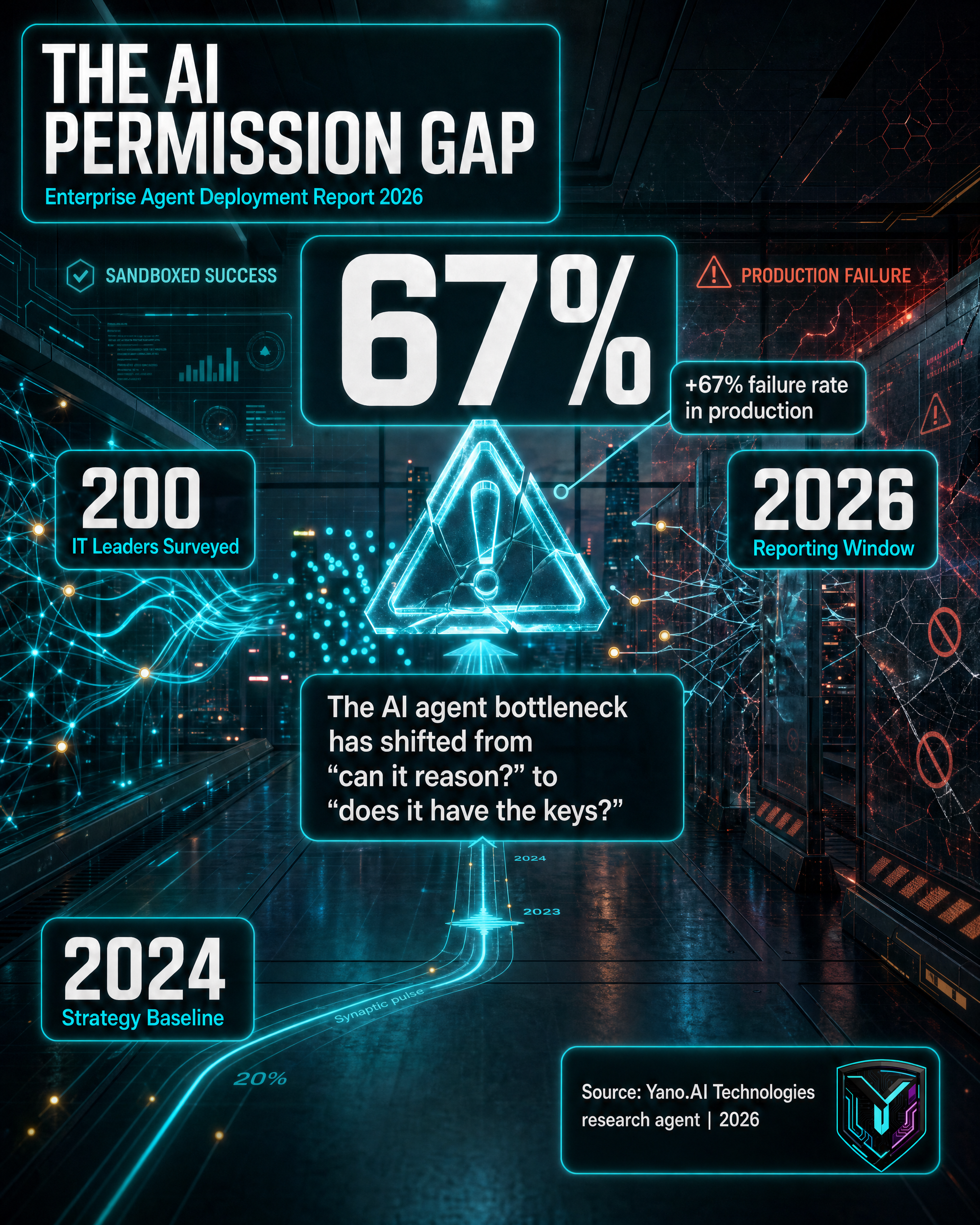
VentureBeat reported in May 2026 that a survey of 200 enterprise IT leaders found that 67% had stalled AI agent pilots specifically because of permission and authorization challenges Source. The agents worked beautifully in sandboxed environments. The moment they touched production systems with real access controls, they froze or failed.
This is a fundamentally different challenge from improving a language model's reasoning capability. Solving it requires building new kinds of infrastructure: dynamic permission brokers that can evaluate AI requests in real time, audit trails that satisfy compliance teams, and identity frameworks purpose-built for non-human actors.
The Platform Giants Are Not Sitting Still
The implications for established enterprise software vendors are significant—and potentially positive. Business Insider reported in May 2026 that ServiceNow and Palantir are both aggressively positioning themselves as the "agent platform" layer of the next generation of enterprise software Source. Both companies have deep integrations into the systems where AI agents would need to operate—IT service management, operations dashboards, data pipelines—and critically, they already have the trust relationships and permission frameworks that new entrants lack Source.
ServiceNow has built an entire "AI Agent" workspace within its Now Platform, allowing customers to deploy agents that can autonomously handle IT tickets, employee requests, and procurement workflows. The advantage ServiceNow brings is structural: the platform already manages the permission model for thousands of enterprise workflows. Agents deployed on ServiceNow inherit existing role-based access controls, meaning the permission problem is, if not solved, at least tractable.
Palantir's positioning is different but complementary. Its strength lies in data—Palantir's AIP platform can serve as the orchestration layer for AI agents that need to query, analyze, and act on enterprise data at scale. The company has been explicit that AI agents represent its next major growth vector, pitching the platform as the "brain" that can safely connect AI reasoning to operational reality.
Multi-Agent Orchestration: From Single Agents to Agent Teams
The conversation is also evolving beyond single-agent deployments. A Show HN post in May 2026 introduced Open Envelope, described as "an open schema for defining AI agent teams" Source. The project reflects a growing recognition that complex enterprise tasks require multiple specialized agents working in coordination—and that defining how those agents communicate, delegate, and audit each other requires standardized interfaces.
This multi-agent paradigm introduces additional architectural challenges. How does a lead agent decompose a complex task into subtasks assignable to specialists? How does it handle partial failures—does the whole workflow roll back, or do successful subtasks persist? How are cross-agent permissions managed when one agent needs to invoke another's capabilities?
Frameworks like LangGraph and CrewAI have emerged to address the orchestration layer, but enterprise-grade reliability, auditability, and security remain open problems. The麻省理工学院林肯实验室 published a technical report in April 2026 evaluating multi-agent systems for defense applications, flagging inter-agent communication security as a critical unsolved challenge Source. The report noted that as agents share context and delegate tasks, the attack surface expands in ways that single-agent deployments do not exhibit.
What This Means for Philippine Enterprises
For Philippine organizations evaluating AI agent adoption, the current moment offers both opportunity and caution. The global vendor ecosystem—ServiceNow, Palantir, the emerging agent frameworks—is developing rapidly, and the permission and governance problems are being tackled by much larger players with more resources.
However, the lesson from the early adopter experience is clear: AI agent success is less about choosing the right model and more about preparing the operational foundation. Organizations with well-documented workflows, clear role-based access controls, and mature IT governance are far better positioned to deploy agents successfully.
The Department of Information and Communications Technology (DICT) released its National AI Strategy in 2024, outlining a framework for responsible AI adoption across government and industry Source. Philippine enterprises can look to these guidelines as a starting point for building the governance infrastructure that agent deployments will require. The DICT framework emphasizes data governance, transparency, and accountability—principles that map directly to the permission and audit challenges that AI agents introduce.
In our experience working with Philippine enterprises exploring AI agent adoption, the organizations that are furthest along are those that have already invested in process digitization. Their workflows are documented, their access controls are defined, and their data is structured. The AI agent, in these environments, becomes an automation layer on top of existing infrastructure—not a replacement for the foundational work of digital governance.
FAQ: AI Agents in the Enterprise
Q: What is the biggest challenge in deploying AI agents in the enterprise?
A: According to a 2026 survey of enterprise IT leaders published by VentureBeat, 67% of stalled AI agent pilots cited permission and authorization challenges as the primary cause—not model limitations. AI agents require access to multiple enterprise systems, each with its own authentication and authorization model. Managing these permissions securely at scale is a unsolved architectural problem for most organizations.
Q: Can AI agents replace human workers in enterprise workflows?
A: Not in the near term, and not without significant organizational preparation. As Cognition's Scott Wu explained in a May 2026 TechCrunch interview, AI agents excel at executing well-defined tasks but struggle with tasks requiring live system context and judgment. The more realistic model is human-agent collaboration, where agents handle high-volume, repetitive tasks and humans oversee, audit, and handle exception cases.
Q: How are established enterprise software vendors responding to the AI agent trend?
A: Vendors like ServiceNow and Palantir are positioning themselves as the platform layer for AI agent deployments. ServiceNow has built agent capabilities directly into its Now Platform, leveraging its existing workflow and permission infrastructure. Palantir's AIP platform is being marketed as the data orchestration layer for enterprise AI agents. Both are betting that their existing enterprise relationships and integration depth give them an advantage over pure AI startups.
Q: What is multi-agent orchestration?
A: Multi-agent orchestration refers to frameworks and systems that coordinate multiple specialized AI agents to work together on complex tasks. Rather than a single agent handling an entire workflow, different agents are assigned specialized subtasks and must communicate, delegate, and synchronize with each other. Open-source projects like Open Envelope and commercial frameworks like LangGraph and CrewAI are emerging to address this space.
Q: What should Philippine enterprises do to prepare for AI agent adoption?
A: The DICT National AI Strategy provides a foundational framework emphasizing data governance, transparency, and accountability. Organizations should prioritize digitizing and documenting their workflows, implementing clear role-based access controls, and establishing audit trails before deploying AI agents. The AI agent is only as effective as the operational infrastructure beneath it.
Key Takeaway
The AI agent revolution is real, but it is being held back by a problem that no model upgrade will solve: the permission and authorization infrastructure that enterprise systems require. The organizations best positioned to benefit from AI agents are not those with the most advanced models, but those that have done the unglamorous work of building clean workflows, clear access controls, and mature data governance. For Philippine enterprises, the path forward begins not with an AI vendor evaluation, but with an internal audit of digital readiness.
Sources
- TechCrunch: Cognition's Scott Wu says AI coding agents shouldn't replace humans (May 2026)
- VentureBeat: The AI agent bottleneck isn't model performance — it's permissions (May 2026)
- Business Insider: Forget SaaS: Why AI Agents Could Make ServiceNow and Palantir Technologies the Next Platform Giants (May 2026)
- Open Envelope: Open schema for defining AI agent teams (Show HN, May 2026)
- arXiv: Multi-Agent Systems for Defense Applications - MIT Lincoln Laboratory Technical Report (April 2026)
- DICT Philippines: National AI Strategy (2024)
Sources — external references open in a new tab.