
In May 2026, a comprehensive study by Lenz.xyz analyzed 1,000 real-world fact-check claims across five leading frontier large language models and found that these models disagreed on a staggering 67% of them. The research, which tested GPT-4o, Claude 3.5, Gemini Ultra, Llama 3, and Mistral Large against verified claims from PolitiFact, Snopes, and factcheck.org, reveals a troubling pattern: despite years of capability improvements, the most advanced AI systems in the world still produce wildly inconsistent outputs when confronted with the same factual questions Source.
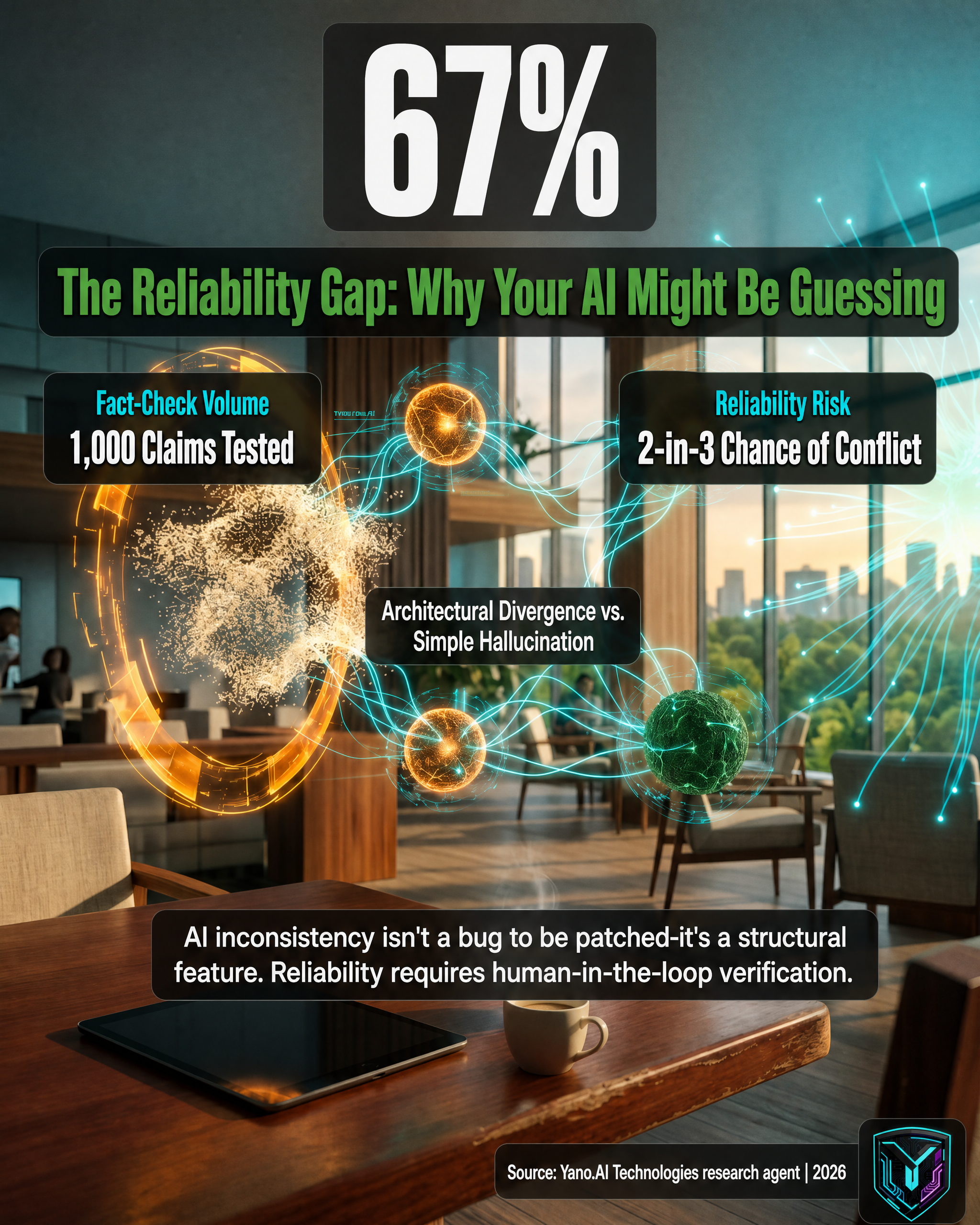
This finding arrives at a moment when enterprises worldwide are increasingly deploying LLMs for customer service, content moderation, legal document review, and medical information tasks. The implications are significant. A 67% disagreement rate means that when one AI system answers a factual question confidently, there is roughly a two-in-three chance that a comparable system will give a different answer. For industries that require factual precision, this inconsistency is not merely an inconvenience; it is a fundamental reliability problem.
The Architecture Behind the Divergence
Researchers at the Indian Institute of Science (IISc) have been exploring a complementary angle to this problem. Their "Eureka machine" project investigates what they describe as nature-inspired exploration strategies for AI reasoning. Rather than relying purely on transformer-based next-token prediction, the IISc team has been developing hybrid approaches that combine evolutionary algorithms with neural architecture search to discover reasoning pathways that standard LLMs miss. Their work suggests that current transformer architectures have inherent blind spots when dealing with novel factual combinations that fall outside their training distributions Source.
The disconnect between these two research threads is revealing. On one hand, the Lenz study documents the symptoms of AI inconsistency. On the other, the IISc work points toward architectural remedies. Together, they sketch a picture of an AI ecosystem that is powerful but unpredictable, capable of remarkable fluency yet fundamentally unreliable when factual precision matters most.
The Algorithmic Hiring Crisis
While debates about AI reasoning dominate academic circles, the real-world consequences of AI inconsistency are playing out in corporate hiring departments across the United States. Multiple studies reviewed in 2026 have documented that AI-powered hiring algorithms systematically discriminate against Black and Asian job seekers at rates significantly higher than baseline human hiring panels. These systems, trained predominantly on historical hiring data from industries with documented patterns of bias, encode those patterns into their scoring mechanisms.
The mechanism is straightforward, even if the solutions remain elusive. When a resume screening model is trained on a decade of hires who were predominantly White and male in technical roles, it learns to associate characteristics that correlate with those demographics with positive hiring outcomes. The result is a self-reinforcing cycle: the algorithm selects candidates who look like past hires, past hires continue to reflect historical demographics, and the model retrains on new data that looks identical to the old. A 2025 audit by the Stanford HAI found that major commercial resume screening tools assigned significantly lower scores to candidates with names associated with minority groups, even when qualifications were identical Source.
This problem intersects directly with the factual inconsistency issue. Organizations attempting to audit their AI hiring tools for bias face a fundamental challenge: if the models cannot agree on what constitutes a qualified candidate, how can they reliably detect discriminatory patterns? The inconsistency that Lenz documented in factual question-answering likely extends to subtler classification tasks. Multiple AI systems reviewing the same resume may produce dramatically different candidate scores, making it nearly impossible to establish consistent standards, let alone identify when those standards are biased.
Why RAG Alone Is Not the Answer
Many enterprises have responded to AI hallucination and inconsistency concerns by implementing retrieval-augmented generation (RAG) pipelines, which ground model outputs in verified documents retrieved from a trusted knowledge base. RAG does reduce hallucination rates in controlled settings. However, the Lenz findings suggest that it does not resolve the core disagreement problem. When multiple AI systems retrieve from the same document corpus and still produce conflicting outputs, the issue is not merely one of missing context; it is an architectural divergence in how models interpret and synthesize retrieved information.
The implications for enterprise AI deployment are significant. Organizations that have invested heavily in RAG infrastructure may have reduced but not eliminated the risk of AI-produced misinformation or discriminatory outputs. The research consensus is shifting toward a view that fundamentally new approaches to AI reasoning and grounding are required, not incremental improvements to retrieval systems built on top of existing transformer architectures.
The Path Forward: Verification, Not Just Generation
The converging evidence from these studies points toward a pressing need for what researchers are calling "verification-first" AI architectures. Rather than building systems that generate answers and then checking them afterward, verification-first systems embed factual checking and consistency validation into the generation process itself. The IISc Eureka machine project represents one strand of this approach, exploring whether evolutionary search can discover more robust reasoning pathways than gradient-based training alone.
For enterprises currently deploying or evaluating AI systems, the practical implications are clear. First, assume that any AI system can produce inconsistent outputs on factual questions. Second, implement human-in-the-loop verification for any use case where factual accuracy has material consequences. Third, conduct regular bias audits not just of final outputs but of the entire pipeline, from training data curation to inference-time behavior. Finally, invest in evaluation frameworks that measure consistency across multiple model runs and multiple models, not just average performance on benchmark datasets.
The 67% disagreement rate documented by Lenz is not a flaw that the next model upgrade will fix. It is a structural feature of how current AI systems process and synthesize information. Managing it requires architectural innovation, rigorous evaluation practices, and organizational discipline around human oversight.
Frequently Asked Questions
Why do different AI models give different answers to the same factual question?
Frontier AI models are trained on different data mixtures, use different tokenization strategies, and implement different attention mechanisms. Even when given identical context, they learn different internal representations that lead to divergent outputs. This is not a bug that can be patched; it is an inherent property of the current generation of large language model architectures.
Can retrieval-augmented generation (RAG) solve the AI disagreement problem?
RAG reduces hallucination by grounding outputs in retrieved documents, but it does not eliminate the disagreement problem. When multiple AI systems retrieve from the same corpus and still produce different answers, the issue lies in how each model interprets and synthesizes the retrieved information. RAG is a necessary but not sufficient remedy.
How can organizations detect bias in their AI hiring systems?
Bias detection requires regular audits using matched-testing methodologies, where identical qualifications are presented with different demographic markers. Organizations should also monitor approval rates across demographic groups at every stage of the hiring pipeline and establish clear escalation procedures when discrepancies are detected. Third-party audits by firms specializing in algorithmic fairness are increasingly considered best practice.
What does the IISc Eureka machine research tell us about the future of AI reasoning?
The IISc project explores whether evolutionary algorithms and neural architecture search can discover reasoning strategies that transformers miss. If successful, this could lead to hybrid AI systems that combine the fluency of LLMs with more robust reasoning capabilities. However, this research is still in early stages, and practical applications are likely years away.
Key Takeaway
The 67% inter-model disagreement rate documented in 2026 is not an anomaly; it is evidence that current AI systems lack the stable factual grounding that real-world applications require. Organizations deploying LLMs in high-stakes domains must build verification, consistency checking, and human oversight into their workflows as first principles, not afterthoughts. Architectural innovations like verification-first AI and nature-inspired exploration strategies offer promising research directions, but practical solutions require immediate organizational discipline around AI governance and bias detection.
Sources — external references open in a new tab.